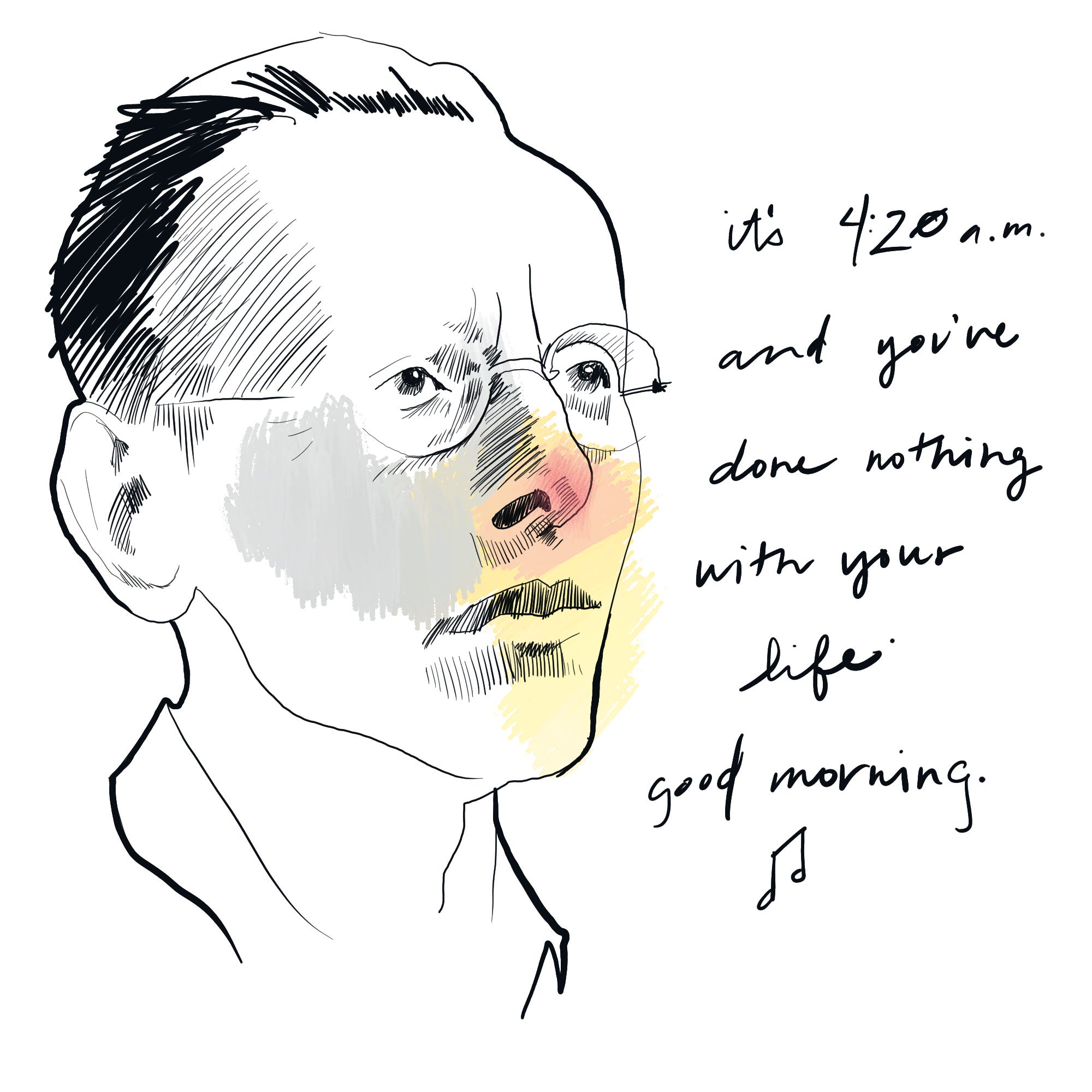
Applying Carl Orff therapy to the potheads living below my apartment.
No, marijuana isn't harmless, and also, enjoy 4:20 a.m. operatic wake-up calls.
Many years ago, my German sister Bine gave me a Carl Orff CD.
I have received many German classical CDs from her, often dark, brutal, and a reminder that Chopin’s Polish version of melodic depression is very different from most German composers’ versions; it is the difference between writing poetry and sharpening axes. It has often seemed to me that German composers were either overly jolly with beer, waltzes, and positivity, or starting a metallurgical war.
Anyway, in the immediate years after college, I would paint while listening to classical music, and the music would affect the final results. I can tell you, just by looking at some of my old paintings, what I was listening to, even if I can’t specifically remember.
Using medieval texts, Carl Orff composed Carmina Burana, a 20th-century cantata that blends secular songs in Latin, German, and French, some of which live up to the subtitle (Cantiones profanae) of “profane songs.”1 O Fortuna opens and closes the entire work, framing the entire piece by showing Fortune to be a wheeled behemoth that raises people up and crushes them, from whisper to overwhelming. In modern soundscapes, O Fortuna (or variations on its theme) is woven into soundtracks to signal when something momentous or heroic is about to happen. It’s one of those tunes you’ve probably heard in movie soundtracks without realizing it, such as Excalibur, The Hunt for Red October, and, unfortunately, Jackass: The Movie.
Speaking of getting medieval on someone, and jackasses, and acting as the Empress of the World, let me tell you about my apartment on 6th Street.
Working at a bakery at the time meant getting up very early. I would walk eight blocks through downtown to get to work. My apartment was in a small house-like building, and the apartment below me had three different occupants during my stay.
Two guys rented it at the end of my lease, and they liked to smoke pot. I could smell it through the vents and floors. They also must not have had any job because they were always there, apparently sleeping during the day and up at night. At 2 a.m., I’d wake up to Guns N’ Roses or AC/DC blaring below my bed. I was already struggling with exhaustion, and these two nimrods weren’t helping.
“Shut up!” I’d yell down at the floor. “I’m trying to sleep!”
“F*ck you!” they’d holler, laughing and turning the music up louder.
Every night, the same.
My landlord was what the Swedish call a paragrafryttare, or “paragraph rider,” someone who was very much a stickler for following his rules down to the last dot. I actually appreciated it, since I’m a rule-follower myself, though when I received the long list of what was required to clean the apartment (e.g. I had to use Murphy Oil Soap on the floor, and nothing else was allowed) to get my deposit back, I was somewhat taken aback. I did comply; those were the rules.
I didn’t want to be a snitch, but these two morons were killing me. I was dragging myself out of bed and could hardly stay awake at work. About two months into their stay, I’d had it. Knowing my landlord’s nature, I figured it would be easy enough to get these guys kicked out.
But first, payback.
On a Saturday, when I had to get to work early, I waited until I could hear them snoring. It was about 4:15 a.m., close to the magical pothead witching hour; I figured they’d fallen asleep an hour or so earlier and should have been in a nice, deep REM state. Pulling my small stereo off my dresser, I quietly set it on the floor and detached one speaker from the side, stretching the wire out as far as it could go. Lying down on the floor, I pressed my ear against the wood and moved around until I could hear the snoring the loudest.
They were right beneath me.
Carefully placing the speaker face down on the floor in that location, I popped in my Carl Orff CD, turned the volume up to 11, and let the glorious sounds of O Fortuna roar.
Enjoy, boys.
Within seconds, I heard the sound of glass breaking, perhaps the result of one of the brain-cooked low-IQ inebriates knocking a glass or lamp off a table. This was followed by some bumping, thumping, and copious amounts of swearing.
I hit replay.
Various hollering and curses were directed my way, but I was too busy directing the imaginary choir and living every classical music lover’s dream of being the maestro. When the last note rang out for the second round, I hit stop. I called my landlord on my break at work and explained that the two guys renting below me were smoking pot. An hour after I got home from work, I heard him pounding on their door, and by Monday, they were gone.
I have no remorse about this.
I regret nothing.
I would do this again.
I might even add Wagner’s Ride Of The Valkyries to the mix. Maybe, if you couldn’t take a hint, Strauss’ Also sprach Zarathustra fast-forwarded to about one minute in would make an appearance. Chopin is my favorite, but I’m part German as much as I’m part Polish, and by golly, I will blast your ass with German confrontational orchestral triumph if you interrupt my sleep in such a disrespectful and purposeful manner. I will help you have a bad day.


Though any live performance of O Fortuna is going to knock your socks off, you’re probably not going to see a better performance with the amount of potential drama than André Rieu live at the Maastricht in 2012, so turn up your speakers and enjoy.
Unless you’re a pothead.
I don’t care about your “glaucoma.” You get no sympathy from me.
“Carmina Burana: Who Wrote It, What It’s About and What Are the Lyrics,” Classical Music, accessed January 8, 2026, https://www.classical-music.com/features/works/carmina-burana-lyrics-composer.


Orff is one of my all-time favorite composers also. I was fortunate enough to play Carmina Burana in high school band and again later in life. And I took my eldest to see the Minot Symphony perform it live a few years ago. I wholeheartedly endorse and approve your use of this piece.