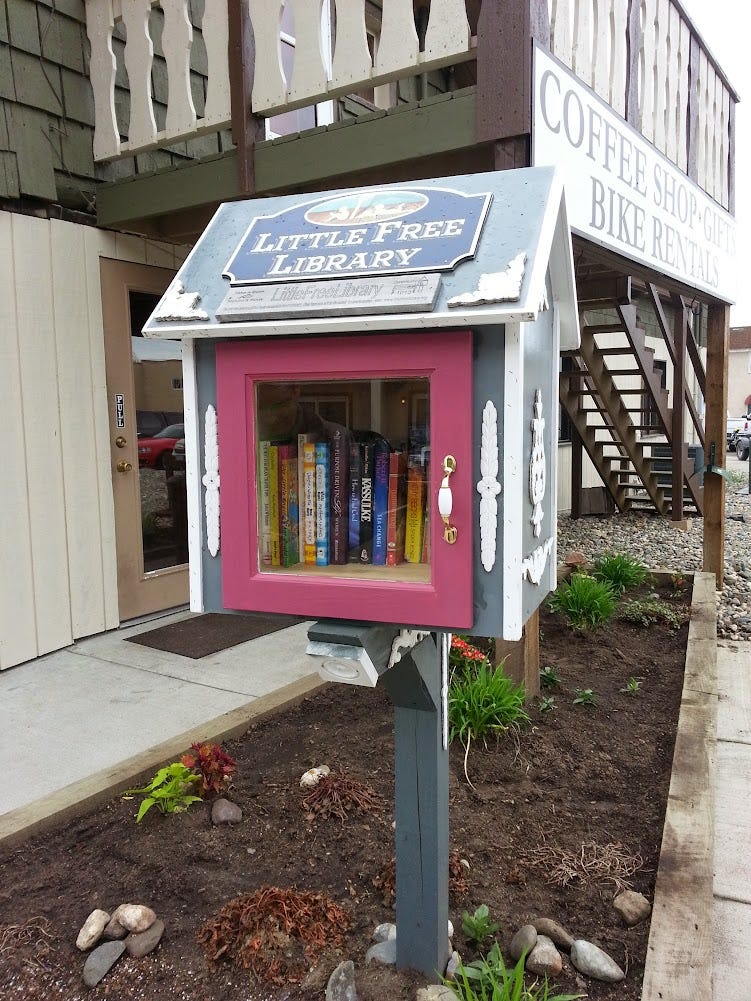
It's time to talk about Little Free Libraries.
The deep philosophy behind just giving books away in a capitalist and ever-illiterate society.
Some data suggests that about 1/5 of American adults are considered illiterate.1 One model suggests that 130 million adults (age 16-74) read below a sixth-grade level. Based on current population estimates, that’s almost 40%.2 In 2022, not even half of American adults read a book that year.3 Modern adult literacy proficiency seems to have peaked in 2017 by some estimates, but overall, basic literacy and participation in reading for kids in school peaked in the late 1980s.4
Etcetera, etcetera.
The numbers keep falling, both on who can read, what level they can read at, and how many bother to actually read books. We all know the drill.
Obviously, this hurts my business model as a writer.
Is there still anyone out there who wants to read a book?5 Is there room in those models of falling literacy and book interest for allowing books to wander about the world, unfettered and free?
We have to go way back.
Before there were Little Free Libraries, there were coffee shops and hotels that allowed people to use an informal leave-and-take book swap system. There was also BookCrossing.com, which stepped up the game a bit in the early internet years and turned it into an adventure.
Total sidebar here, but according to my BookCrossing account, which I created in 2003, I have only officially released four books:
What Should I Do With My Life by Po Bronson (and a fair question), released November 10, 2003, in the United Airlines terminal at the Denver airport, which is Satan’s airport. “Didn’t change my life in particular, but I don’t think that was Bronson’s point, anyway. He seemed to be more concerned with tossing the question out there,” I wrote.
Fatal Voyage by Kathy Reichs, also released November 10, 2003, in the United Airlines terminal at the Denver airport, which is Satan’s airport, I must reiterate. “This book is OK. Something to read to kill time while traveling,” I wrote in my exceedingly deep review.
The Testament, by John Grisham, was released on February 26, 2003, in a gas station in Cando, North Dakota, after reading it on a train trip. “It helped to pass the time across Montana,” was part of my review. You can see why I’ve never been awarded a book critic post. I’m no better than the moron reviewer on Amazon who talks about the shipping and box instead of the product.
The Horse Whisperer, by Nicholas Evans, was released on February 28, 2003, at the Heritage Center in Devils Lake, North Dakota. “The first two-thirds were an OK read, but then Nicholas Evans sold his unfinished script to Hollywood and ended “The Horse Whisperer” in a rather cheesy fashion. The ending (last third of the book) is not in keeping with the rest of the book. Robert Redford did not use this ending in his movie, thankfully. It would have been better if it were more about horses and less about romance. But that’s just me.”
I think I need to get back on BookCrossing and get active.
Since my original foray, I’ve given away about 400 books. The current recipient of what I clear from my bookshelves is the local library. They collect people’s donations, then resell them a couple of times a year as a fundraiser, and everyone who got rid of books stumbles in like an addict to buy more books because it’s just $1 for a bag.
The Little Free Library (LFL) didn’t exist during my mildly active BookCrossing days. I suspect, should I feel so motivated, I could pair BookCrossing with LFL and get a kind of geocaching book thing going.
But let’s get back on track.

LFL got its start in 2009.
Founder Todd Bol created the first Little Free Library, which looked a bit like a one-room schoolhouse, in honor of his mother. My mother would probably be more honored if I mastered the art of putting my socks away instead of leaving them on the floor, so the bar is pretty low for me.
Within just three years, LFL took off.
The original goal was supposedly to build more little free libraries than Andrew Carnegie’s actual library-building record, and they managed to do that by 2012. Granted, it takes less money and red tape to build an LFL than an actual library, but the LFLs tend to take more physical and weather abuse and have less security.
For the record, I can’t get enough of novel ways to get stories and poetry as a physical item into people’s hands. I already wrote about the short story dispenser in the Wichita airport.
But there are also poetry boxes and book dispensers at the state park campgrounds in North Dakota.
“You can just get a book on your Kindle. Lots of free ones,” I’ve been told. This is so much less enjoyable, both to acquire and to read. There’s no sense of a treasure hunt, much like the used bookstore in Mandan, Huntington Books, which was likely a fire hazard but completely glorious.
As if reading was just about the words on the page (or screen). The story about getting the story is part of it.
I take photos of LFLs when on vacation, which is why the condition of some of them is disheartening. If you’re going to be the owner and librarian of such a thing, you gotta take it seriously. You’re the steward of books! Free books! Admittedly, I know you’re fighting against the weather and neighborhood no-goodniks.
It’s not all golden, to be sure, beyond just the structural maintenance. The LFL is good for several things we should have seen coming, but did not.
Getting rid of books that suck.
Getting rid of self-published books.
Getting your self-published book that isn’t selling out into the world.
This list of three could, in some instances, be a Venn diagram that is a circle.
There are other issues, such as spiders. I have found some seriously disgusting spiders in an LFL, but they do not outweigh the treasures I’ve found.
For example, I found an old book about the history of the Red River Valley, the Metis, and ox carts. It was made more interesting by the penciled annotations in the margin in which a highly grumpy reader—someone I can identify with—argued with the author using fine Palmer penmanship. It was like the ancient form of social media, but more perfect: you could yell at the author, and no one would argue, nor would the author care, but you felt better for having won the one-sided argument.
How did we get away from that perfection?
So what could possibly be the controversy around the LFL?
There’s the way people treat private property and their innate desire to ruin anything that’s nice, as well as what kinds of people are attracted to free stuff and how they behave.
I have always wanted an LFL—desperately so, in the worst possible way—in the front yard, but my friend assures me that they attract weirdos.
“I usually stop at an LFL if I see one,” I said.
“My point exactly.”
Let’s not forget the little boy who lives next door to me is also a disobedient hellion beyond belief, with no sense of private property respect, and would no doubt destroy my efforts.
But I still really want one.
There’s also the way people treat anything that is free, too often without self-restraint.
I’ve noticed food pantry versions of LFL, and one fellow in town has placed his LFL in a Little Free Garden for people to help themselves. I don’t know if anyone takes him up on the free vegetables, but the Little Free Food Pantry at a church near where I live often features the same 300-lb guy literally clearing out every last food item into a box he’s carrying. I try not to judge, but clearly I am.
It’s free, yes, but the idea is to take what you need and leave some for others.
Over the years, the other issues with LFLs have been zoning and permitting. Even small libraries have red tape coming for them.
And of course, the permanent “problematic” issues that have infected every part of American life have raised their head here: some think LFLs are performative and inequitable. That is, they are allegedly clustered in wealthier, whiter neighborhoods and have become a sign of gentrification.
Some grumpy pants jerks, who are apparently not aware of the interwebs and all the free books contained therein, have suggested that the LFLs are stealing patrons from local libraries, claiming this is a corporatization of free books and of how literary materials are distributed. (See also: Amazon.) I don’t even understand these concerns. It’s probably mostly HOA presidents who retired way too soon and have a daughter named Karen.
Years ago, when Netflix still sent out DVDs, I was in a bookstore with a friend, and he made the comment that he thought there ought to be a kind of Netflix for books.
“I always thought there ought to be something like Netflix for books,” he said. “You know, where you could get books sent to you in the mail and return them when you’re done.”
I snickered. “There’s already a kind of Netflix for books. It’s called ‘the library’.”
If only there were more little, free ones where, unlike the local library, I wouldn’t have to watch a drug deal go down in the basement while looking on wide-eyed and unarmed from the stacks.
Magnet ABA, “US Literacy Statistics,” last modified December 7, 2025, https://www.magnetaba.com/blog/us-literacy-statistics.
NU Editorial Contributors, “49 Adult Literacy Statistics and Facts for 2026,” National University, June 24, 2025, https://www.nu.edu/blog/49-adult-literacy-statistics-and-facts/.
Sunil Iyengar, “Federal Data on Reading for Pleasure: All Signs Show a Slump,” National Endowment for the Arts, October 2, 2024, https://www.arts.gov/stories/blog/2024/federal-data-reading-pleasure-all-signs-show-slump.
National Center for Education Statistics, “120 Years of Literacy,” Institute of Education Sciences, U.S. Department of Education, accessed March 23, 2026, https://nces.ed.gov/naal/lit_history.asp.
Read. Not listen to, but read. An audiobook is not reading. It’s a radio play or long podcast at best. Most of us listen to it while doing something else. I get it. But it’s not full-on reading.