A buying culture on a no-return trajectory.
I did not know you could return food.
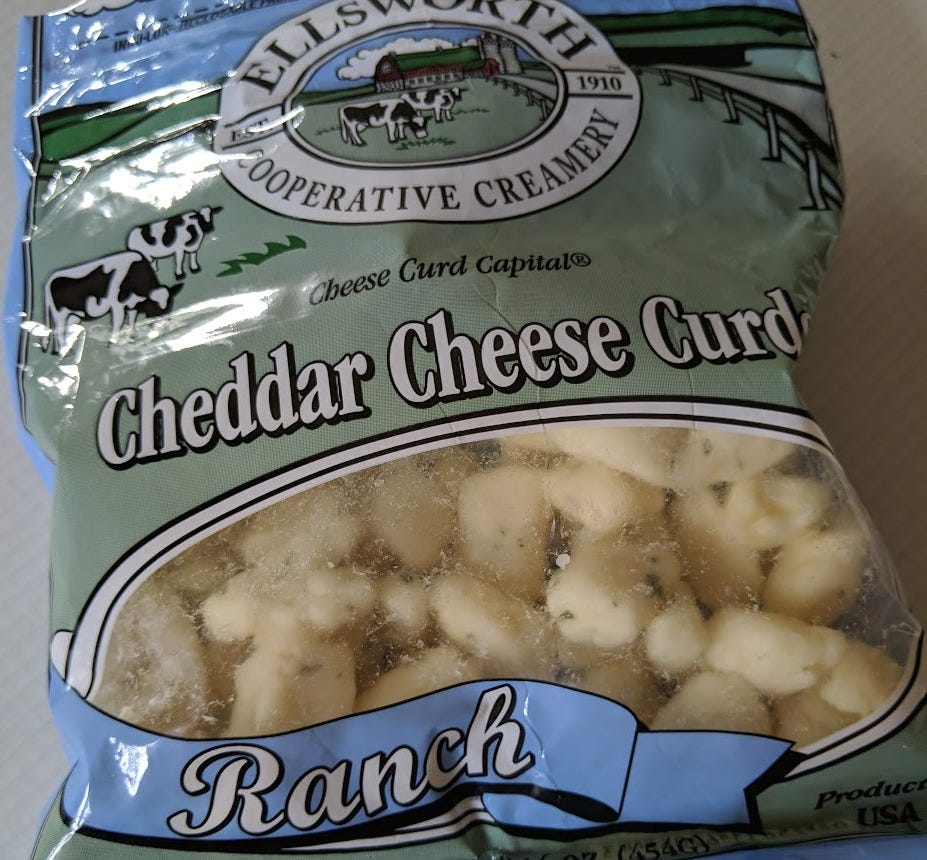
“Was there something wrong with them?” the young store clerk asked the customer, a young woman barely older than her, across the checkout counter. On the belt were two packages of cheese curds and a package of round snack cheese. Both packages were crumpled, as if a cheese pervert had fondled them, and though unopened, could never be put back on the grocery shelf.
“No, I just didn’t need them,” the customer said, explaining she’d had a party and created a charcuterie board, and these were extra.
I was mortified; I didn’t know grocery stores accepted food returns, and I wished I hadn’t known. I trust that a store will create appropriate policies, but I do not trust that individual employees will follow them. How do I know if I’ve purchased second-hand food? Surely they would have to destroy these perishable items and not restock them, thereby eating into their costs and adding to our grocery costs.
“So…okay,” the young clerk said, as confused as I was. “You just don’t want them?”
“Yes, I didn’t need them.”
In the late 19th and 20th centuries, stores began offering return policies that, though specific and limited, were meant to build customer trust. We’re more willing to take a chance on something if we know we can return it should things go poorly. By the 1950s, with the rise of shopping malls, stores offered standard return policies, the idea being less about trust and more about guaranteeing customer satisfaction. By the time the 1970s rolled around, that glorious decade of my birth, the advancement of consumer-rights movements further encouraged clear return polices and fair treatment of customers.
Then we get the 1990s and the internet. To gain customers and get them hooked on online shopping, online retailers popularized the “no-hassle” return. It was easier to return something you bought online—for any reason—than something you purchased in a store.
Here we are, in the 21st century, return policies gone completely haywire and part of the package of total cognitive dissonance in a generation trying to save the world and fight climate change while shopping online and racking up giant carbon footprints from shipping and returns.
Amazon set the standard for a lot of this bad return behavior.
Huge return windows. No questions asked (for the most part), even for clearly used items. No cost to the customer, though there’s a huge cost to the seller: every time you return something for free, not only does the seller eat the free shipping to get it to you the first time, but they also eat the return shipping AND have to refund your money for the item. We like the ease of online shopping, but we also want to replicate the store experience of touching and trying on things before we’re obligated to keep them.
Selling has been ruined, thanks to Amazon. We have a generation of people who understand shopping more like renting or borrowing from the library. Buy, think about it, take it back, expect no expense during the whole process.
I would like to see, frankly, a shift to a “no returns” standard policy. It would help a lot of us stop buying so much stuff; it would reduce clogs in our shipping systems, reduce packaging waste, and make us more careful shoppers. Maybe even better humans, if I dare say, because people who like to return things as a way of life are not on the path to being better humans.
The gal with the fondled cheese that sat on the checkout counter, cheese that had started to sweat, stared expectantly at the clerk, who was obviously as confused as I was about what was happening here. You bought the item. It’s perishable food. You can’t just change your mind and bring it back.
“I only needed two eggs, but you sell them in dozens, so here are the remaining ten. I want a refund,” is basically where we are at today.
I knew those cheese curds were on sale with bonus gas reward points. They were not a hugely priced food item. Less than a Starbucks drink for sure. Yet she was going to return them instead of just eating them? Get some protein in your diet, some much-needed vitamin D up here in the frozen chosen land, and consider it a win!
I started looking around at the magazine rack, pretending I wasn’t seeing this pivotal moment of the breakdown of civilization—returning food items that were otherwise fine, as if purchased on a borrow plan—choosing instead to fixate on the latest edition of MADD magazine and wondering how that magazine had ceased to become satire and instead, accurately depicted the ever strange culture we lived in.
Last January, right after Christmas, I took a book to the UPS store to return it to Amazon because they had sent the wrong book. I could not believe what I was seeing, remembering a few years ago when I’d gone to pick up a prescription and had been shocked by the long line and the white mountain of bagged pills on the counter.
Behind the UPS counter, where exhausted employees were patiently trying to process endless returns, was a mountain of every item imaginable, safe in a plastic bag with a return label stuck to it. The UPS employees were going to spend hours packaging these things to return them, billing the sellers for the cost.
The customer is not always right.
We should be held fiscally responsible when we are doing fiscally irresponsible things.
I know of a woman who needed a dress for a special occasion, and she kept ordering dress after dress—same dresses, different sizes and colors—on Amazon, trying them on, returning them, and returning some she wanted but wanted to stay in the return window so she could buy the same dress she returned later when it was closer to the date.
“Why wouldn’t you just go to one of the cute boutiques in town?” I asked my friend when I was told about this, but neither of us could come up with an answer. The pull of doom scrolling mixed with buying is too much, I guess, and sitting at home on your phone, racking up mindless orders without fear of reprisal, thanks to return policies, is so easy.
My friend used to work at Macy’s years ago and told me about people bringing back shoes or clothes that had clearly been worn, expecting a full refund and getting ugly and abusive about it. I recall, from my bakery days, an ugly and angry bride and her mom coming in on the Monday after her wedding with a tiny bit of cake left, demanding a full refund for an entire wedding cake because “it was dry,” even though it looked like they were able to choke it down well enough. The dad was so embarrassed at their behavior that he eventually left the bakery while the two women screamed at us. I once painted a dog portrait for someone, shipped it, and a week later got an email saying her dog had destroyed the package before she even got home to open it, and could I do another one? I could do another one, I said, but she’d have to pay me all over again. This is not what she wanted.
Your poor financial decision, your choice to go over budget, your shopping whims, your inability to decide or estimate what you’ll need, your naughty dog—that’s on you or me, the buyer. It’s not on the seller; it’s not on the shipping systems; it’s not on whoever else we think should foot the bill because of “customer satisfaction” and “the customer is always right.”
I imagine that if you ordered a portrait and it ended up in your dog’s poop a day after it arrived, yes, you wouldn’t be satisfied with that outcome. But that’s your problem.
We seem to think there’s always some insurance of sorts looming above us that means we shouldn’t be out any money if something isn’t perfectly to our satisfaction, whether that’s a product, service, or experience. We cancel the charge on our credit card, we return, we complain, we leave a bad review, we create an ugly scene in a store so the management gives us what we want to get us out of there. We’re like little kings and queens, wandering about demanding complete satisfaction as if Mick Jagger didn’t already give us a heads up on the likelihood of that.
Friday night purchasing fun has Monday morning regrets. I get it. But that’s not the fault of the seller or service provider. We shouldn’t expect to recoup a semblance of our budget days later on the backs of someone else.
Ultimately, we all pay the cost for this behavior.
Sellers have to bump up their prices to cover shipping and return costs. Some sellers and stores just go out of business since the customer’s demands for satisfaction aren’t based on fiscal reality. The UPS and USPS increase costs and struggle to manage not only the initial shipping costs, but also all returns. Packaging costs (and waste) increase. And of course, like those sad cheeses on the checkout counter, there’s the likelihood that many items have to be discarded because they can’t be resold.
Back at the store, the gal processed the return and put the ever-saddening cheeses behind her so she could ring me up. The customer left, about $9 richer, heading to the Caribou Coffee counter, likely to spend about that much anyway, adding to the grocery store’s cost margin that would eventually hit us all.
It had never, not once ever, occurred to me to return grocery items unless they were spoiled or defective. I had never seen anyone apply the “buy a lot and just return what doesn’t work” mentality to cheese.
The subsection of this discussion is how we give gifts with a return mentality in mind, as if the recipient must not experience the discomfort of receiving a gift that might be outside their usual realm of existence.
The first time I experienced receiving a Christmas gift with a return receipt taped to it—a concept that deserves a blog post of its own—was in college. I was blown away. I did not know that anyone returned gifts, since the act of giving is a tenuous mix of showing love to someone and hoping they would understand that the main message was the intent rather than the actual item. In return, the giver would understand that giving wasn’t a selfish reflection of personal preference but a reflection of the best parts of the person receiving.
Which is why I never buy clothes for anyone.
I have to return pants that are too small, though a big thanks to whoever might have given them to me for their extreme optimism.
I would buy cheese curds as a gift, though.
Which is why the pants don’t fit.


