Rocky Mountain spotted fever isn't so bad I guess.
Mostly because it seems like I didn't get it, and other non-sequiturs.
The camping trip started with a mid-route stop in Carrington, North Dakota, a town much different from the massive geomagnetic event of the same name in 1859. One of the Freedom 250 trucks was parked there, and Gilbert Stuart’s portrait of George came alive and spoke to me.
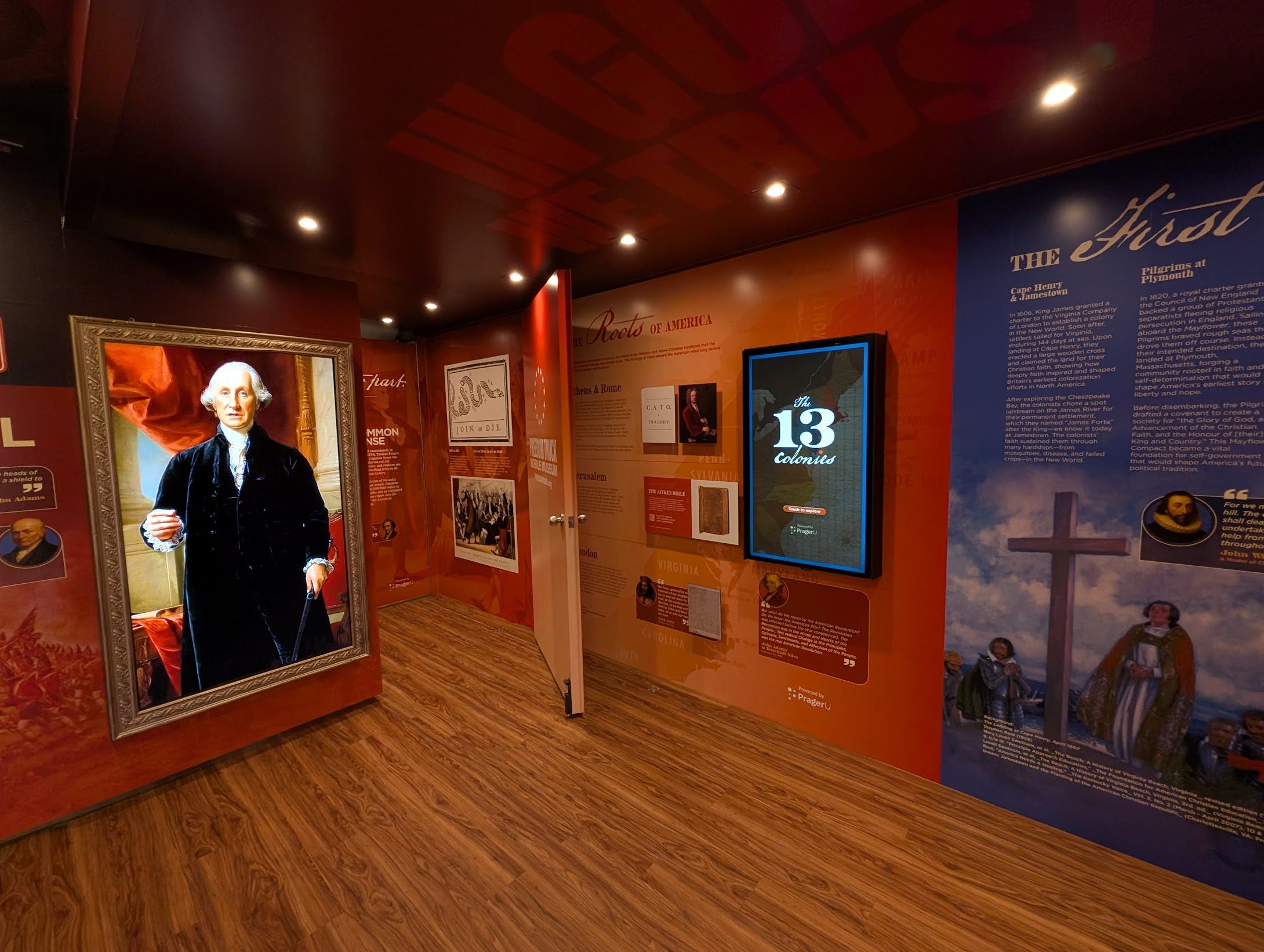
If a truck full of freedom rolls into a town near you, you should go.
After wandering across the street to a vendor under a tent selling T-shirts and coins— “I just follow the truck wherever it goes” — and getting my hands on over-priced patriotic goods, we continued onward and northward towards my nearly-home stomping grounds of Graham’s Island State Park.
The first day of camping with the family is often filled with my sister trying to foist 20 dozen “butt ton” of farm eggs (as she calls it) on everyone, various pliers, head-scratching, wondering if we smell gas, a prayerful decision to spark it, and cheers if the hot water heater works and no one loses their eyebrows.
I’ve seen a gas stove blow out on my mom, though she was totally unaware of the fireball and the soft, snow-like dissipation of the first quarter inch of her hair as it fluttered in the air about her while she pulled a pan of buns out of the oven. The prayer is real.
For fun, the second day of camping was filled with hail.
The Neidlinger party, unlike the Donner party, made it through.
I do like Graham’s Island State Park, though several years ago, after misjudging the capacity of my body to process s’mores in a reasonable manner, I found myself agonizingly stumbling towards the campground bathroom through the dark in the shortcut path through the trees, in between thunderstorms and flashes of lightning, tripping over roots and alighting upon a skunk on my way back. I can’t hold the park responsible, but the people cleaning fish in their campsite and tossing the guts into the trees along the path—you know who you are—most certainly are to blame.
This year, no skunks, and better judgment with s’mores.
We had a little toddler with us who is in the stage of having more energy than nuclear fission while we are all old and trying to cobble together at least four working knees among the five of us. Entertainment consisted of blowing bubbles, and the unfortunate one who wore himself out doing so bought, during the last night of camping and in some desperation while sitting in the campfire glow, a small bubble machine capable of 18,000 bubbles per minute.
“It’s going to blow his mind,” he said.
“It’s gonna be like Lawrence Welk,” my oldest sister said.
“Wunnerful, wunnerful,” I agreed, imagining our campsites, heavy in red, white, and blue bunting and flags, engorged with bubbles.
“Amazon is recommending a foam party machine,” my other sister said, but we quickly denounced that idea for many reasons. That sister called me a few days later to let me know she’d purchased a significant number of fluid ounces of bubble mix at Tractor Supply Company and I’m not sure the park rangers, who once left a little note on the pickup windshield scolding us for having the tire on one inch of the grass, will feel about it.
The next morning, the day of packing up and heading out, I felt a tick stuck to my back. I trotted across the road to my sister’s site; as a veterinary technician, she is our go-to medical officer who is as calm shooting a painfully dying deer with a 9mm that had been hit by a car as she was putting her hands into a heifer’s nether regions. She’s the go-to gal.
“I got a tick on my back,” I said. “I can’t reach it. I’m gonna have to show you some skin and near crack. Sorry.”
She hopped down from her camper, I turned around, and lifted up my shirt.
“Get a room!” my adult nephew hollered across the campground for the convenience of at least four other campsites as my sister leaned in close to my backside to remove the tick. I threw a gesture at him to silence his insolence, feeling the tug of skin as the tick was pulled out.
“What kind of tick is it?” I asked nervously, pulling my shirt back down as I turned around.
“Just a dog tick,” my sister said. “It wasn’t even buried in that far.”
That’s a relief. Only Rocky Mountain spotted fever or tularemia to worry about, not Lyme’s disease, or never eating beef protein and dairy again in my life. But ticks always leave me feeling violated. Insects that are “buried in” the body are a SyFy monster movie nightmare.
I’m currently relegated to straining in the mirror to see if there’s a Target ring forming on my lower back.
I write about camping a lot. A quick search brings up posts tackling such a simple activity from a variety of angles, though often involving fire. It’s no surprise, really; camping is an affordable summer activity in North Dakota, which allows you to avoid heavy tourist crowds because there aren’t any in North Dakota.1
Last year, over the Fourth of July, while at Icelandic State Park, we watched a jacked-up camper pull into the campsite across from us, and about fourteen Ukrainians poured out, narrowly missing the water spigot with their camper bumper by about four inches. They seemed a jolly bunch, exuberant and very free with the fire starting fluid. At one point, when the flames were several lengths above their head, and the smell of the fluid made me question why anyone would love the smell of napalm in the morning, my friend shared a story of his youth, one I had heard that always made me laugh.
It was a rough area of St. Paul, he explained, the kind where you don’t go across the street to offer cooking suggestions. The neighbor, whom they called Fat Ma, lived in a run-down house full of kids with constant traffic in and out.
Somehow, a huge rack of ribs landed in her possession. They watched as she pulled a rusty charcoal grill to the front yard, filling it with charcoal. It soon became clear she had not done this before, apparently thinking that charcoal was supposed to have constant flames.
When the flames subsided, she’d use lighter fluid to keep the flames going. With a toxic fire roaring, she dropped the ribs on the grill. The fire subsided, so out came the lighter fluid marinade. This went on for some time. Not long after, there was a shooting in the neighborhood, but probably not because of the ribs.
“I wonder what that tasted like,” my friend often says at the end of the story. If our olfactory senses are any indicator, based on the Ukrainian campers, I have a pretty good idea.
I won’t pretend I’m any better.
We still talk about the time my brother was tossing canola seed sacks into the burning barrel on the farm (we burn our garbage to mixed results), and instead of staying upwind, we gathered around and oohed and aahed at the colorful flames licking at the likely toxic chemicals from the bags. We took photos, trying out the new slow-mo features on our cameras, re-enacting some kind of modern version of primitives dancing around a fire.
It’s hypnotism, even if it’s garbage.
Fire draws you in. We have nice state parks, and closing out the day by the campfire as the sun slowly sets around 10:30 p.m. on the northern plains is magic.
Fire at night is where you spill your secrets, where stories take on new drama, where my sister’s dumb jokes make us all giggle, where smartphones hinder. I’ve been trying my hand at campfire stories, though I’ve yet to finish them, customizing them for family members and their phobias, made a bit simpler by my eldest sister’s propensity for listening to podcasts about cryptozoology.
But also, there are mosquitoes and ticks, and this is a fallen world.
Medora and the Theodore Roosevelt Presidential Library, opening over the Fourth of July in 2026, an official America 250 activity, is the exception.


