
Are you a traveler or a tourist?
An ode to North Dakota and why people foolishly skip such places.

I have two questions for you today to help you determine if you’re a traveler or a tourist.
The first question is: what do you think of North Dakota?
If your answer is that you don’t, you’re not alone.
This is a state that has been lumped in with South Dakota as just “Dakota.” People then confuse the location of Mt. Rushmore. It’s the last one they visit on their quest to visit all 50 states. It’s a state where, if Americans do visit, they tend to either go to the far southwest portion (Medora and Theodore Roosevelt National Park) or the far southeast portion (Fargo). The northern tourists tend to be from Saskatchewan and Manitoba, not Americans.
On July 1, 2026, for one brief moment in time, it was cool to be from North Dakota.
I mean, it’s always been cool in my book; there are very few true NoDaks in this world of 8 billion people. But on that day, President Trump visited, flying the new Air Force One on its inaugural flight, taking Marine One out to Dickinson, then riding the BNSF Freedom Train to Medora, where the Presidential motorcade was escorted into town by the people who portray the Roughriders for the Medora Musical.
My heart swelled with pride in my state. Social media was full of incredible photos of Medora and the rest of the spectacle, including the amphitheater where NoDaks have been going to the Medora Musical—which usually includes a Teddy Roosevelt look-alike as emcee and a dramatic re-enactment of the Battle of San Juan Hill, including one year they accidentally lit the butte on fire—for decades. People gushed about the newly opened Theodore Roosevelt Presidential Library, glorying in the Teddy Roosevelt and North Dakota ethos, finally using the word “North” instead of just “Dakota” with no mention of Mt. Rushmore.
I was elated. I’ve been writing about my state on my website and in other writings for 30 years, and finally, at long last, people could place it on the map.
That moment was gone in one day, however.
Those same media personnel and self-important members of podcastistan who had flooded the internet with their visitor cool factor and proof of being on Air Force One, checking the “I was there first” box at the new presidential museum, moved on to the next thing, which happened to be South Dakota, and…Mt. Rushmore. And then the big fireworks show in D.C. where world records were broken.
We’ve trained ourselves to think experiences that matter happen within hours, we can and should move on to the next one, and that this is traveling. We have an awful lot of people entangled in FOMO, YOLO, and LIWHHYBNSI.1
To be fair, news reporters are logically enslaved to its pace and the locations where news is happening, but it seems as if news reporters and influencers have blurred the lines, creating less news reporting and more “follow me for more proof I’m in the inner circle.” They aren’t necessarily going to where something newsworthy is happening, but trying to make it newsworthy by their presence. Social media feeds filled with proof they were present at the Current Big Thing are wearying. It’s supposed to be a news report, but it’s an unintentional narcissism report. And that’s what descended and left, within a span of a few hours, in North Dakota. They hyped, and hit the road.
Amid all the excited social media noise of July 1 came the unfortunate comments to the effect that, with the new Theodore Roosevelt Presidential Library, people at last “had a reason” to visit North Dakota.
“There was always a reason to visit,” I finally snapped back, tired of my state being the butt of jokes. One man said that he had never heard a bad word said about my state in his entire life, to which I indicated disbelief. “We are always the punchline,” I said.
“Maybe it’s a Midwestern thing, because on the East Coast the only comments I’ve heard about ND are how awesome it is,” he replied. I was desperate to hear more about this, but did not.
A small hope sparked in my heart, because I do love my state.
I mean, I really love it.
I’ve been all around America, to Europe, the Caribbean, Central and South America, Canada, Australia—I want to live in North Dakota. I really do. Of all the amazing places I’ve been, North Dakota is my favorite. Whatever the road trip or the travels, however fun and exciting they might have been, the moment I set foot in North Dakota, I always let out a dramatic sigh of relief and say, “We’re back in God’s country!”
Home is where the heart is, I guess, but small, unfamiliar places like North Dakota aren’t in too many people’s hearts.
They mean so little that people can’t locate them on a map, much less say anything significant about them, a realization heightened by observing FIFA World Cup travelers enjoying the U.S. and mistaking BBQ, Texas, Buc-ee’s, and the South or the East as the full understanding of America. They wondered online where to go next, and all the replies were obvious: big cities or the South, specifically Texas or Florida. It started to feel as if they were all trying to get a photo of themselves eating Texas BBQ as proof of the American experience.
I’m just going to say it: I’ve been to Texas many times. It’s okay. But I don’t want to live there.2

I do understand the World Cup travelers, somewhat.
I’ve often been the tourist in an unfamiliar place, struggling to find a way to talk about it that doesn’t come off as assumptive and arrogant. I know that my culture (national, regional, and familial) affects how I view and compare what I experience. I often pick up travel guides and flip to North Dakota to read the outsider’s description—written as if they had inside information—on our cities and attractions as a model on what not to do as a writer.3
The United States is huge; each state is unique, and within each state there are regional differences. You simply cannot take it all in and grasp it on a singular visit because I can’t do it in an entire life. The main information I want from such traveler’s guides is which parts of a city or region I’m most likely to get carjacked, assaulted, or stumble upon a cartel-funded grow. That’s pretty much it.4
Cultural anthropology is hard.
As with everything in life, it’s easier, especially as a visitor with limited time and context, to understand the Big Obvious Symbol that can sum up a place or experience in a moment, like a rodeo or the Washington Monument or a pile of BBQ ribs. These are especially valuable if you need to post photos on social media of what you’re seeing and doing as proof of having an interesting life (more on that in a moment).
Until July 1, no one craved proof they’d been to North Dakota, because North Dakota isn’t a Big Obvious Symbol of anything. It isn’t even a place. It’s a euphemism.
The Red Hot Chili Peppers, Bob Seger, Lynyrd Skynyrd, Lyle Lovett, and even Kid Rock—these are the ones that come to mind—have dropped North Dakota into their lyrics as the epitome of nowhere, a place of remote nothing that you travel through. It is the location foil to any place you’d rather be, desolate, abandoned, forgotten. You could go to the moon or to North Dakota, same difference. It’s a metaphor for bleakness and heartache. North Dakota is the easy way to say “way out there” or the place you left for better things. Or for cold. If you want to find an American alternative to Siberia, you say North Dakota.
The films have done it, too.5 And so have television shows.6
The joke is not the people or the place, but on the outsider who uses them as a symbol for their own artifice. North Dakota is the literal center of the North American continent, tremendously wide open and like an endless sea with unfettered horizons and four distinct seasons, and in light of Yeats’ poem “The Second Coming,” you ought to have a little more thought for that center and hope that it holds.
Why Do We Travel?
All of that leads me to the second question: why do we travel?
I travel not to get away and relax—it’s more relaxing to be at home—but because I’m curious and like to learn and experience the places I’ve only read about. I want to better understand history by visiting the places events happened. I want to experience a place and a culture. I guess I travel to expand how I understand the world. It always gives me something to think and write about.
But more importantly, it fills me with gratitude for the life I have where I live.
G.K. Chesterton said that “the whole object of travel is not to set foot on foreign land; it is at last to set foot on one’s own country as a foreign land,” and he is correct. Nothing makes me appreciate home as much as traveling elsewhere. (See also: World Cup travelers who marveled at things I took for granted.)
But Chesterton took it further. “The traveler sees what he sees; the tripper sees what he has come to see.”
Now we get to the heart of it. The reason we go someplace affects how we experience it.
This is the difference between a traveler and a tripper (tourist). It’s okay to be a tourist if you know that’s what it is. On my budget, I’m mostly a tourist. Tourists can be frustrating to non-tourists unless they have the self-awareness not to be total d-bags as visitors in a place they don’t belong. Social media tourists are even worse, coming to see what there is to see not because they are interested but because they want others to be interested in them for having been to the place.
Today, 50 percent of people choose a destination simply because they want to show it off in their social media feeds. This makes it difficult for those who live in these destinations, for those trying to enjoy it honestly as a slow-traveler, and for younger generations who are coming to a wrong understanding of travel not to broaden the mind and understand your own home better, but instead as proof of social clout.
Getting the best vacation photo has turned classic and popular destinations into a nightmare of waiting in lines for hours so you get a turn at having the photo for your Instagram account. Private property and sensitive landscapes are trampled for that photo. Instead of the place changing the tourist, the tourist changes the place, and for the worse.
For the tourist, this kind of travel shortchanges them.
It was 2015, and I remember standing on the observation deck of the Empire State Building, in awe of the view and the moment, overwhelmed by the size of the city, but also confused by all the selfie sticks. “Their heads are going to be in the way in the photo,” I told my friend. “You won’t be able to see the scenery.”
I didn’t realize yet that the scenery wasn’t the point. Proof of being there was.
We’re playing some kind of game of who wins at being the most places. This is peak social media tourism, where the point of travel is to get photos of specific destinations and post them online so you can get likes and build your platform.
Places like North Dakota don’t do well with this social status traveling, with some exceptions. Thanks to July 1, people will think North Dakota is the tiny region around Medora, and getting your photo at the new T.R. Presidential Library will have social status. The lesser-known parts—the places that don’t scream selfie because they are better translated in-person than in a photo—will still go unknown. Stand in tall grass on a windy fall day, and it will feel like being in the ocean—completely mesmerizing—though your photo is going to be lackluster.
We have to be able to exist well in the unseen, lesser-knowns without applause.
Pursuing a destination is a closed-end result. There is no destination that lives up to the hype, so we keep planning more destination vacations.
When you celebrate the journey, as a traveler would, it’s different. It’s a process. Even a small trip can be traveled in this way. I like to start every trip with “here we go!” and view it and whatever happens on it as the grand adventure. It makes it easier when plans go awry, for one thing, but also prevents the crash-down of spirits when getting back home, avoiding the financial trap of chasing travel highs non-stop.
So, what can you do to be a little more traveler and a little less tripper—enjoying the journey instead of chasing the destination—and find the lesser-known places of enjoyment?
Skip the interstate and take smaller highways. Try geocaching, which will take you to lots of offbeat places. Use paper maps instead of Google GPS; they have points of interest you’d otherwise miss. Keep an as-you-go travel journal, and be creative about all that you put in it. Buy postcards of the standard vista and put them in your journal. You start to appreciate a place when you try to write and draw it in real time. Choose your own adventure instead of letting social media do it for you. Change the definition of what’s interesting, and be open to your travel photos including close-ups of interesting small rocks along the road (true story).
I’m not against documenting your travels. I’m not going to say don’t take photos; I take a lot both to remember what I did on the trip, to build my own stock photo repository, and to recall the day when I write about it that evening in my travel journal. But keep most of the photos private so they stay yours, and the temptation to do things that make others envious is reduced. Photos should be part of an entire experience, not get in the way of a real experience.
And also, just so we are clear: North Dakota is a wonderful, beautiful place that you should not save for last.
But, on the other hand, if you’re dismissive of quiet places that require thoughtful consideration, then frankly, it’s okay with me if you never come here. Because box-checking visitors can ruin a place for the rest of us.
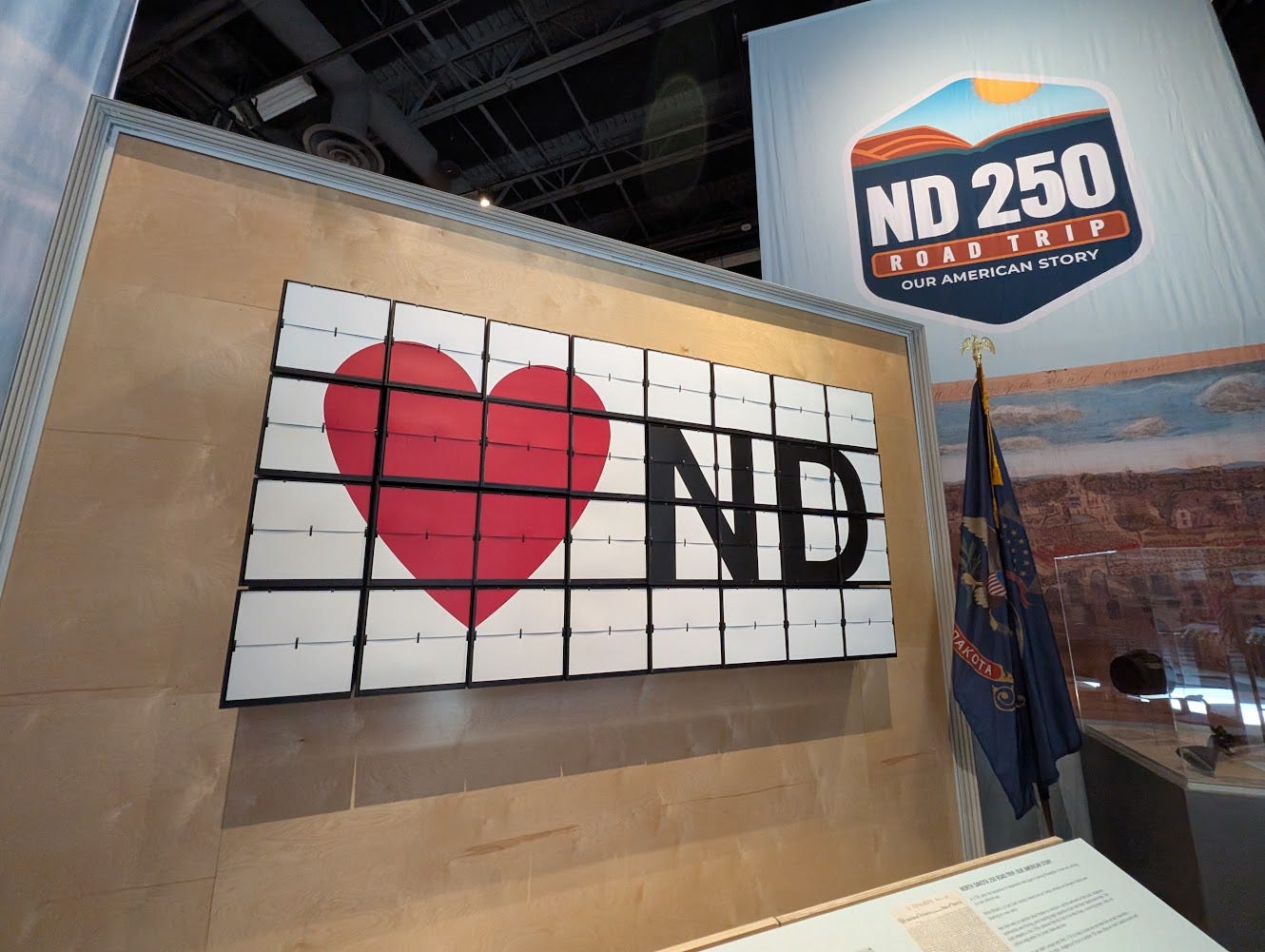
Video is from the wonderful North Dakota Road Trip 250 exhibit at the Heritage Gallery in Bismarck, 2026.
Look, I was here. Have you been? No? Suck it.
Devils Lake, a town south of where I grew up, was described as “rough and ready” in one guide, and years later, I still can’t figure out what they meant. Rough and ready compared to…the Upper West Side?
Tourism departments have the odd conflicting task of boiling down a place to its bare, easily grasped stereotype for effective marketing, while also trying to provide real context so a place is understood and appreciated instead of simply used and assaulted. You want to attract people using language and images they understand on a broad cultural level, but you also want them to appreciate the place when they arrive; otherwise, they attribute wrong ideas and attitudes to what they are seeing or experiencing. This is tough to do in today’s short-attention-span, social proof, theme-park culture, which is why travelers leave bad reviews of National Parks.
Our national parks are assaulted by too many tourists who want to take pictures of the notable features with their face in front of it, to trespass where they’ve been told to stay out, and to consume and conquer nature in a way that belies the purpose of it as a salve. They harm the thing preserved for their enjoyment. There are so many wonderful state parks, scenic drives, and small towns that could help spread the tourism burden, but national parks have become the checkbox for travelers wanting the “American” experience. Do you know what Lead/Hill City/Keystone, SD, and Mt. Rushmore are like in peak tourist season? Hell.
Coyote Ugly made sure viewers knew that being from North Dakota was a dark secret to hide. My state gets compared to someone’s back in the movie Twins. Sleepless in Seattle placed Duluth in North Dakota as the standard “we don’t care about flyover country” joke you’d expect from Nora Ephron. Horror movies, though never filmed here, love them some North Dakota as a setting, such as The Messengers and one of the horrible Leprechaun movies. Then there’s Fargo (pro tip: it was set in Minnesota), which created a caricature of North Dakotans and further bloated Fargo’s head (pro tip: Fargo is basically Minnesota). There was an X-Men movie where the actual lat-long (approximately 48.9770333, -102.155491) for mutant Eden—a place they could go to be left alone—drops you in North Dakota. Wooly Boys was set and filmed here, but it’s not a great movie. Let’s hope North Dakota-based Canticle Productions can do us proud.
There was the Don Johnson TV show supposedly set in the oil fields of North Dakota that lasted about five minutes, maybe because they had mountains in the Bakken oil fields, as if we were Colorado. In three separate episodes of The Simpsons, North Dakota is the place of last resort. Conan O’Brien took a few digs at the state, as did many during the oil boom, when all the mainstream news could report on was the gritty stripper-hooker-wild-west that came with oil money. Michael Moore, that great documentarian who loves to defecate on the idea of the Prime Directive and force himself on a place, did a segment on North Dakota for TV Nation, making us look like rubes, idiots, and worth ignoring. My favorite TV show, Psych, mentions Bismarck, North Dakota, to suggest sweet, trustworthy innocence in a character who ultimately turns out to be the murderer. At least The X-Files took North Dakota as a serious location, as did Jeff Fahey’s show The Marshal (sort of).