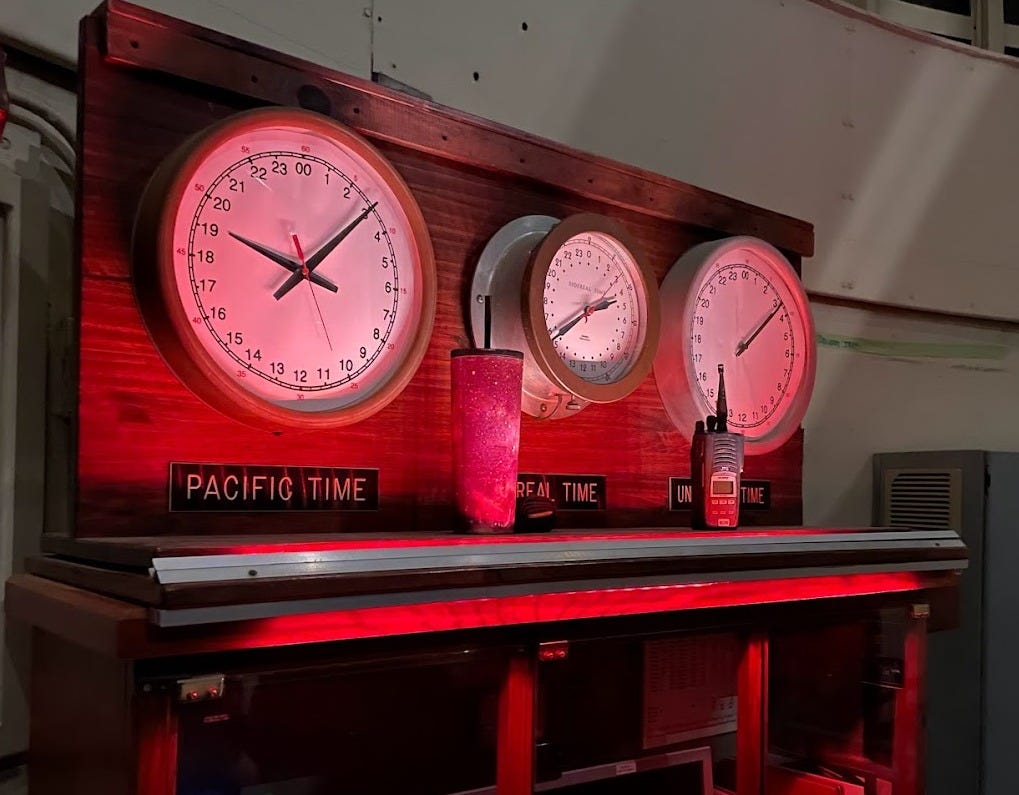
When time stands still for us, but not the people around us.
There is a time for everything, even when we'd like to argue otherwise.
Ecclesiastes tells us there is a time for everything under the sun. (Ecclesiastes 3:1-11)
“There is a time for everything, and a season for every activity under the heavens,” the passage starts, and then lists the most impossible collection and pairing of events that you could imagine. Birth and death, starting and stopping, gathering and casting away, war and peace, searching and giving up, loving and hating.
It’s hard to remember that everything has its time.
When something terrible happens, time seems to stop.
Life around us continues, some kind of blasphemy to our pain, carrying on as if nothing had changed. We feel as if we grow old in a moment, while those around us end up so far away that we can barely communicate with them.
A moving clock ticks more slowly than one that is standing still.
This is time dilation, where time passes at different rates depending on who is observing it and their position and motion relative to others within a gravitational field. Time dilation has been observed; fast airplanes and satellites have shown us that it happens.
The faster you move, the slower time passes.
Time dilation is a favorite mind-bender of hard science fiction, and for good reason. We are trapped in time, seemingly plodding along at the same pace until we die, but this is not the case.
Consider the thought experiment known as the Twin Paradox, in which a set of twins is separated, one staying on Earth and the other traveling through space at near light speed. The twin, moving quickly through space where time moves more slowly for her, returns to Earth younger than her other twin, who had remained at the same speed the entire time. The Earth-bound twin went through more time than the space-bound twin. Though they are identical in DNA, their experiences through time have altered them.
The speed at which we go through life seems to age us at different rates, and the things that drag our being into a near standstill seem to pile on the years.
A few years ago, in the days between Christmas and the New Year, my brother died.
Or at least, he should have.
Barring the small miracles of where he was and who was with him, he is not dead. They brought him back and got the pumps going again. His ringtone on my phone, which has, for years, been Star Trek: TNG’s Worf growling out “it is a good day to die,” suddenly became less of an inside joke and more of a deep philosophy.
I still have the same ringtone, though I thought about changing it. Every time he calls me, I’m now reminded of God’s ungraspable will. Plus, my brother finds it funny. I can’t explain why humor helps, the same way I can’t explain how we mark our personal time, how we set up our own personal BC and AD. 1
Before or after the marriage.
Before or after the birth.
Before or after the divorce.
Before or after the arrest.
Before or after the pandemic.
Before or after the death.
Before or after getting fired.
These rare or first-time experiences stand out because new or unusual experiences hit our brains hard and lock a memory—even if it’s the memory of how we felt, rather than the specifics of the moment—as an important point on our timelines.2 In those memorable moments, time feels expanded, and maybe even seems to slow down.3
That’s wonderful if it’s a good moment, that we can savor it a bit more, but too often it’s the painful moments we wish to walk through much more quickly. I have a fear that Psalm 23 is not describing a short travel through the valley of the shadow of death, but a long one.
It is not always possible, when the thing happens, to realize we’ll end up using it to mark our personal timelines and break our lives into the chunks we think make the most sense. Those moments seem too big, too overpowering, to use so callously as a mere tick mark on a timeline. But the further we get from them in time, the more they fade, just a bit, until they become a soft emotion and marker on our timeline.
Memories are personal road signs, the important ones we try hard to hold onto, though we know they muddle and fade. Ebenezer Scrooge, a lifelong unhelpful character, was given an ironic first name, one that means “stone of help” in the Bible. An Ebenezer is a personal or group reminder of how God helped us. For the Christian who believes God will work all things out for His purpose and our good—even the bad things—we can understand why we might memorialize both the dark days and the light.
It will make sense in time.
But it does not make sense in the moment.
We will still try to make sense of it as soon as we can, often reverting to the idea that “everything happens for a reason.”4
“Getting over a painful experience is much like crossing monkey bars. You have to let go at some point in order to move forward.” — C.S. Lewis
Let’s remember the Twin Paradox, and consider the paradox part: who is older than whom depends on where you are observing.
On Earth, the twin in steady speed experiences a straight timeline. The space twin’s timeline bends, going outbound, then turning around to come back. The straighter the path, the more time there is, yet we know life on earth is fleeting. The path isn’t straight. How good is that God, outside of time, sees and hears our prayers.
One of the greatest things about Heaven—second to being in God’s presence forever—is being set free from time.
I don’t think we realize what the bounds of time do, how so much of our pain and fear are hooked to experiencing time.
And because God created us to be eternal, I don’t think we realize how hard it is to understand anything that matters within those bounds. We see eternity and infinity, and our hearts shout and cry at the same time.
BC means “before Christ,” while AD is Anno Domini, meaning “in the year of our Lord.” The current BCE (before common era) and CE (common era) are woefully stripped of the obvious timeline they rest on, and translated into making common what was not common. This is the thoughtless friend who dismisses your personal timeline whenever you bring it up.
“I Tried Waking Up at 5 a.m. for 30 Days. Here’s What Happened,” The Epoch Times, updated May 1, 2026, accessed May 5, 2026, https://www.theepochtimes.com/health/i-tried-waking-up-at-5-a-m-for-30-days-heres-what-happened-6018846.
Katharina Klencklen, Karolina E. K. Koch, Rachel M. Taylor, Verena Wilms, and Matthias Brand, “Effects of Exploring a Novel Environment on Memory Across the Adult Lifespan,” Scientific Reports 12, no. 1 (2022), https://doi.org/10.1038/s41598-022-20562-4.
“Everything happens for a reason” is a New Age idea that is a twisted version of “God’s will” or Romans 8:28. It relies on concepts of fate, the universe as an entity, and even Karma. It is a human way of dealing with bad things. Christians know that God uses everything for his purpose and will, even though he doesn’t cause or force things to occur unless he wants to. That means that even though he would not will us to sin, he can still use the broken results of our sin and turn it into something beautiful—though it still may be painful for us—in the ultimate scheme of things. We may never see that beautiful thing or fully understand it.
The problem with “all things happen for a reason” is that not only are we shirking responsibility for our actions, but it also turns things into a game. If everything happens for a reason, it becomes a scenario of equal and opposite reactions, of perpetual motion. Something occurs, and what we think is the reason appears. Perpetual motion machines do not need God, nor do beings who self-determine what big things mean when they can’t possibly know.
There is no justifiable reason to sin in order to get the resulting consequence (i.e., “the reason”); instead, God would rather we did not sin, but he is capable of redeeming, and so he works it out for good. He is not surprised by the decisions we make with our free will; therefore, he knows how all things will ultimately work out for good because he has told us the end of the story.
For Christians, it would be better to say, “God didn’t cause this; he is good, and he can use this dark thing for something good someday.” There are many people whose lives seem filled with levels of pain and sadness that are unfathomable, while others have much less hurt in their life. It is an unbalanced thing, this world. We don’t explain pain by trying to balance it.
In the context of this essay, in the moment it feels better to tell ourselves that everything happens for a reason, but the truth is, God works things out for the ultimate good in time. For him, being outside of time, it is all momentary. For us, it takes too long, and we look for a quick emotional balm.


