


First, read the post above. This is the follow-up.
Let’s establish a couple of things at the start:
The purpose of the first article was to share a story about something I had discovered, and to use it to show others how to evaluate a website or product and decide whether it was wise to purchase there. It was also intended to help people make better purchase decisions amid a viral trend.
This post continues telling the story by sharing what happened afterwards. At no time in this foray will I ever tell you that a specific company is a scam, since the definition of what constitutes a scam varies from person to person.1 I will simply provide you with the details of the story and leave the conclusion to you.
On January 27, 2026, I received an email in the evening. The subject line is the kind of thing that every content creator dreads, though it was not my first rodeo. During the pandemic, I’d had a run-in with a copyright troll.
Email Subject: Valorrea - Demand for Retraction and Removal of Defamatory Statements
Someone named Yordan Terzov, with a Gmail address, sent a boilerplate email demanding I take down my original post about the 52 Week Systematic Theology Book for Kids. He sent it on January 27, 2025, at 5 p.m. from his time zone.
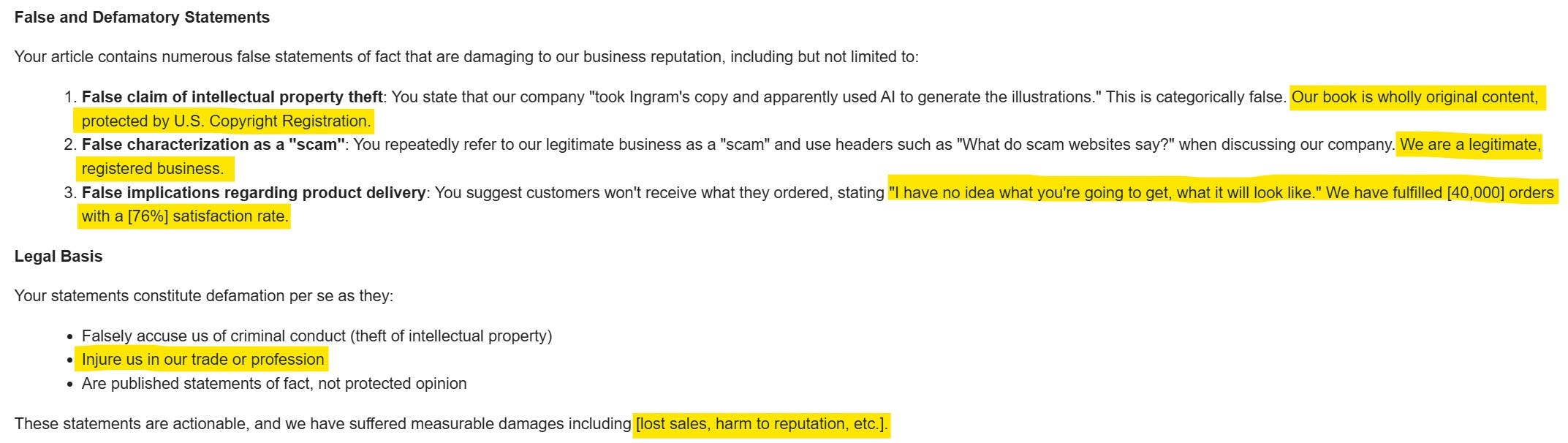
Note the yellow-highlighted items in particular, as we’ll be addressing them throughout this article.
The last one, the [lost sales, harm to reputation, etc.], is how I knew it was likely AI-generated since that should have been replaced with actual copy pertinent to the claim, as it had been elsewhere in the email. For extra curiosity, I ran the copy through several AI checkers, and they all rated it as highly likely AI-generated.
Additionally, the email abruptly ends. There is no signature, no sign-off, no legal disclaimer, and no indication of a law office. I know, from past experience with the copyright troll, that lawyers love them some big signature blocks and with a light CV and admonitions. This email had none of that.
In my initial reply to Yordan, I stated that I disagreed and explained why for each of his points.
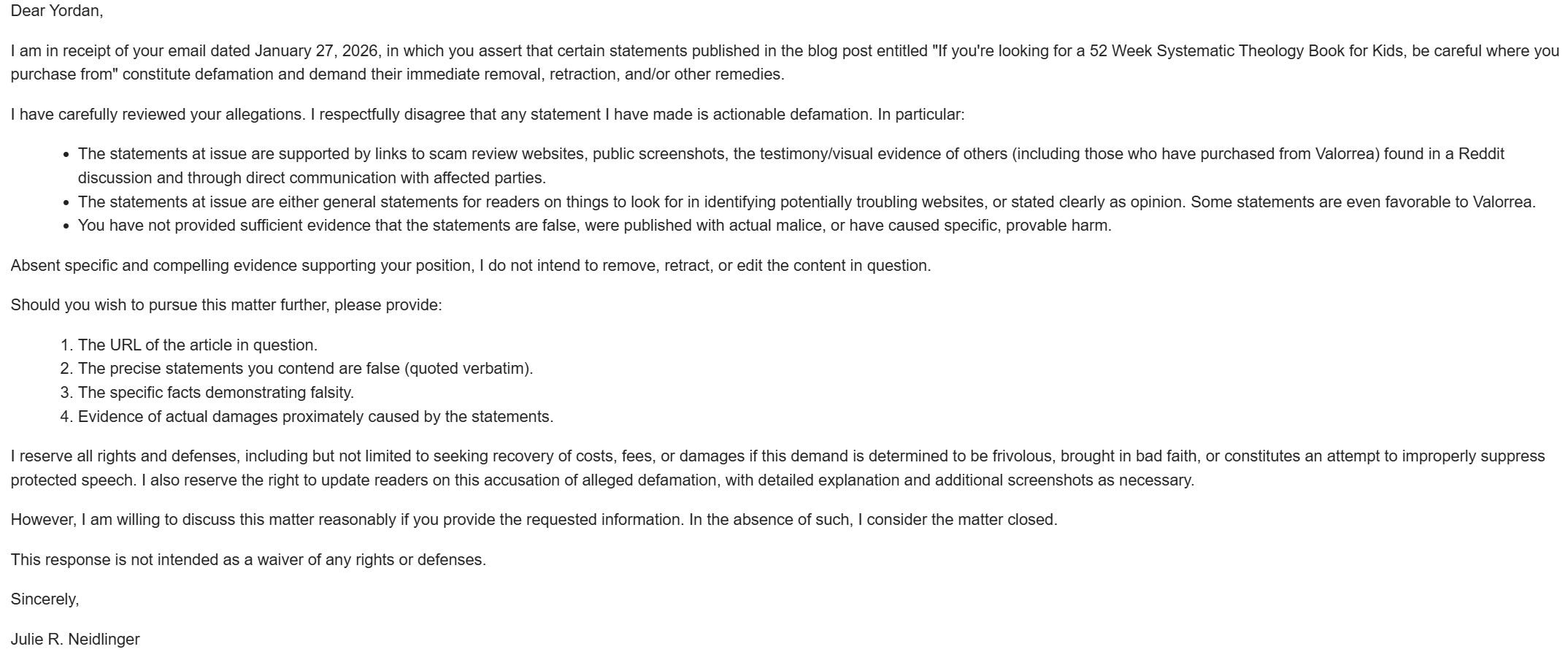
Yordan responded.

Here is the video attached to that email:
The video was interesting because it showed a different book than the one others had received from Valorrea; I do have photos of the different book, but have not shared them publicly. It also looks different from the interior screenshots that had been on the company website for a while (as seen in the first blog post).
I don’t know the timeline for when these two versions were offered, so, as you’ll see in a later email of mine, one question I wanted an answer to is whether there was more than one version. It matters because even if the book shown in the video is the one they offer now, the earlier version had content from another author’s book, as noted in the first post.
I also want to make a point about scary-sounding legal language so you can use this understanding in your evaluations of websites and products elsewhere. Don’t be fooled by phrases that suggest legitimacy or suggest more than they mean. Please note I am not a lawyer, nor am I offering legal advice. I’m basing this on general knowledge and personal experience to merely help you parse the language being used:
Patent-pending: This simply identifies a stage of a process and means nothing other than they applied for a patent and are waiting to see if they got one. Anyone can apply for a patent for just about anything. It means nothing other than they applied. It’s not proof that they’ll get a patent or that their product works.
Patented. Again, it means nothing beyond the patent office determining that whatever was patented was somehow different from anything else. It isn’t a statement about whether the item works or not. A patent simply grants rights that exclude others from making or selling the invention. It has nothing to do with effectiveness, safety, or quality.
FDA registered. This applies to things like health supplements. Again, it doesn’t mean the product is proven to work or has FDA approval. It simply means the supplement complies with DSHEA (1994). It is an administrative step, not a review of the actual product.
Registered business in the United States. This means the business has formally filed with a state or federal authority to operate legally (e.g., a Secretary of State to register a business name). However, registration does not guarantee legitimacy. It simply means they have completed the administrative and legal steps to register to do business. No one has verified the legitimacy of their business beyond the specifics of that task. Many a registered business has proven unsavory, despite registration.
Copyright and Trademark registration. These mean something. Again, pending doesn’t mean much, but actual registration does. If you have a registered copyright or trademark, that means the USPTO recognizes you own the creative work or the trademark (the latter within defined usages), and others cannot use it beyond legal definitions of use. In the U.S., copyright is automatically granted to creators at the moment they create something. Registration is formal and locks it in, eliminating any legal doubt, with real legal advantages established in a public record. When someone claims a registered copyright, it should be registered in the USPTO. I know from personal experience (a copyright, two trademarks) that the USPTO moves very slowly. Registration takes many, many months.
The last one matters because Yordan claims the book they are selling is registered with a U.S. Copyright, and you’ll see that I’m going to ask him to provide that registration number. I did try many searches to find their book in the US copyright system, but without luck.
I responded to Yordan:
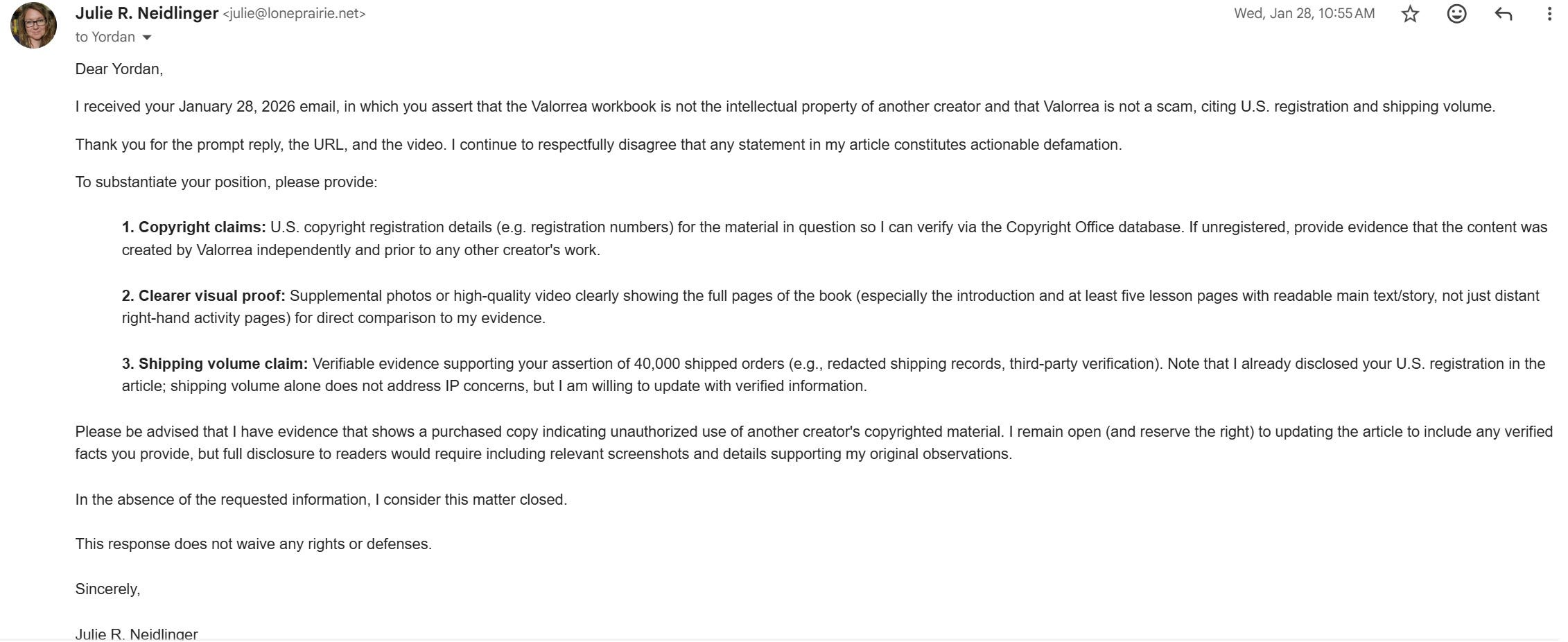
One thing I did not pursue in my email responses is the evident mixed message: Yordan claims my initial blog post harmed sales, yet also uses high sales as proof of legitimacy.
Yordan responded:
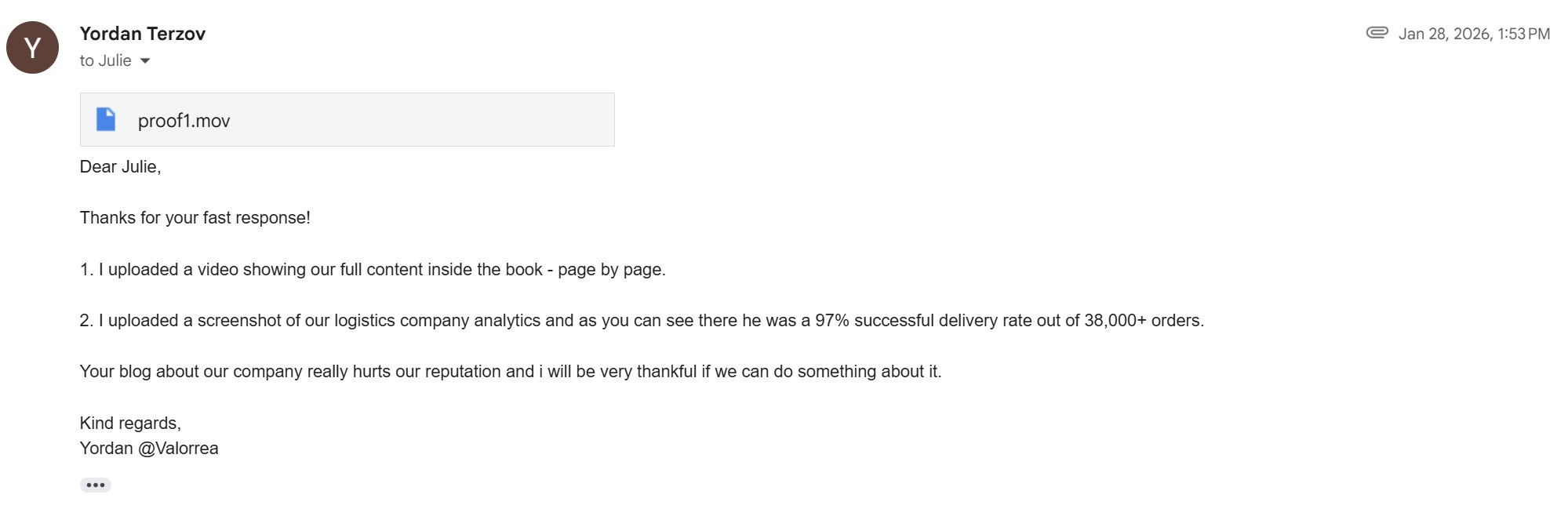
He attached a screenshot of their sales and another video. I am not going to share the sales screenshot as I feel that is private to Valorrea, and I don’t think sharing their tracking software account details is appropriate.
However, the screenshot shows that from Dec 1-31, 2025, they shipped 38,755 items (Valorrea has other products on its website, so I’m not sure if this is their total items or just the book in question). Their delivery rate for that period was 94.36%. Impressive, yes?
What does that prove, however?
Yordan has connected the number of shipped items and the delivery rate as proof that they aren’t a scam (at least I think that’s what he’s trying to show). In my original post, I don’t outright say they’ll take your money and not send you anything. I only show, through screenshots of the product on their website and other customer discussions found online, that what you would get was unclear, when you would get it was unclear, and that the initial product screenshots appeared to contain copyrighted content.
Here is the video he sent in the second email. If you’re genuinely interested in purchasing this book, you can see what it ought to look like. It doesn’t look terrible, but again, I have seen images from a book that look very different from this one. It’s hard to know what to make of that.
You will note it is still hard to see the left-hand side of the book, save for one page, which is where the potential copyrighted content would be, based on the evidence I have.
However, I wanted to be fair; Yordan was certainly sending me information. I responded one last time and included questions I had based on my ongoing research (more on that in a bit). If he could answer, wonderful. I would be quite happy to update readers and dispel any rumors or concerns about this book. I wanted to give him the opportunity.


As of February 20, 2026, I had not received any further communication from Yordan. My offer still stands; if he provides answers to these main questions, I will absolutely update readers, and happily do so.
But let’s get to a new concern: scaring people into silence.
The Fear Of Legal Fees
This nation needs tort reform and legal protections for the little people who don’t have large bank accounts, so we can’t be shut down by the mere threat of legal action. There must be a greater burden placed on those trying to shut down someone’s speech.
I know at least one other person received a similar accusatory email from Yordan, and there was at least one Reddit thread talking about this book that was suddenly removed. I can only speculate, but my guess is that Valorrea, experts in virality and search engine optimization, turned those skills around and used them to hunt down anyone saying negative things about them.
I don’t like this approach of scaring people, of banking on the fear of legal fees wiping them out, even if they are eventually exonerated, in order to take down blog posts. You can write cautiously, use phrases such as “in my opinion,” and try to show both sides as best you can, while still providing a service to people looking for information, and still get hit. Then you gamble on whether it’s a bluff. It’s easier to pull something down than take the chance.
This whole thing was a disgusting approach, especially so for a company like Valorrea, which has clearly positioned itself as a seller of Christian products. Shame on them for sending out emails that hit inboxes right before bed and inspire fear and sleepless nights. How Christ-like of them. If their product is completely on the up-and-up, God will see that it succeeds as he wills.
When I first got the email notification on my phone, my heart skipped a beat. Here we go again, I thought, another copyright troll or something.
The first email contact Yordan should have sent out was not a boilerplate defamation threat. It should have been a friendly email asking if we could talk about the blog post and the concerns he had with it. You catch more flies with honey. His approach immediately put me on the defensive and, as you’ll see, made me dig further.
I had to decide what to do in that moment. I went back and read the original post, which I had tried to write fairly and carefully. I believed it stood on its own. Then I took a beat, re-read the email, and logically dissected it. Who sends an AI defamation takedown notice? I wondered. This is our future, I fear, AI as lawyer.
What were the ultimate results of this tactic?
Posts on this blog go behind a paywall after four weeks unless I choose to make them freely available. Comments are for paid subscribers only. The original blog post was just about to slip behind a paywall, and if I had not been contacted by Yordan, it would have been locked away with only paying subscriber access. I permanently unlocked it so others could read it and opened up the comments so people could share their stories, since the aggressive email approach made me realize maybe there was real importance in that blog post. More flak over the target, etc.
I decided I’d better start doing my own investigation beyond what I’d initially written, since I was going to have to defend myself. Where there’s smoke, there’s fire.
I headed to Facebook, where all dark and dank things start.
Facebook And Viral Fear Posts.
Facebook has a lot of blame for this. The focus of the advertising and alleged word of mouth for this product seemed to be on parents and grandparents (the main Facebook demographic). Make it happen there, and you’re in like Flynn.
The reason I wrote the initial blog post was because of—and I’m sorry to out my parents this way—a bank warning for potential fraud. It popped up on my phone, an attempted suspicious purchase at the Valorrea website. I called my parents.
“We wanted to get this book, but we can’t seem to get our card to work on the site,” my mom said.
I hopped online, and it wasn’t long before I was thankful that the bank refused to allow the charge. “Let me find out more about that book, and if necessary, I’ll see if I can get it from a reputable site the bank won’t have a problem with.”
Yes. It was a bank fraud alert that led me to look into Valorrea.
I wrote the post to share my concerns based on the light digging I’d done for my parents, and I thought that was that, but after Yordan’s scary email, I knew I needed to gather even more information. I started poking around to see where everything had started, and found some Facebook profiles that seemed suspicious.
I made note of several Facebook profiles that seemed to be the source of the emotionally charged stories of kids losing their Christian faith. One, in particular stood out.
On January 28 at 11:58 a.m., I attempted to call one of these Facebook identities, “Emily Carter,” whose only apparent activity was promoting Valorrea products with no other typical past history. I also attempted to contact via Messenger from the “Emily Carter” profile, a white, grandmotherly-looking woman supposedly from Whiteriver, Arizona, who had the phrase “grateful for the highs, learning from the lows” in her profile.2 By that point, she already had 46K likes and followers. By February 19, 2026, she had 50K likes and 51K followers. People were still trickling in; the posts were still being shared.


As you can see in the above images, the profile photo of Emily Carter is almost certainly AI-generated, though the comments section of the one post she has, which is this profile photo, is filled with people responding unaware of what they are dealing with.
And, as you can also see included in the above screenshots, I also called “Emily Carter” and this is the result:
Emily Carter’s only activity on Facebook was pushing narratives designed to emotionally persuade people to buy from Valorrea. She apparently had no other interests. As of February 20, 2026, searching for her name still returns posts pushing Valorrea products. Here is one example, but I have saved the many screenshots of the rest, should I ever need them:
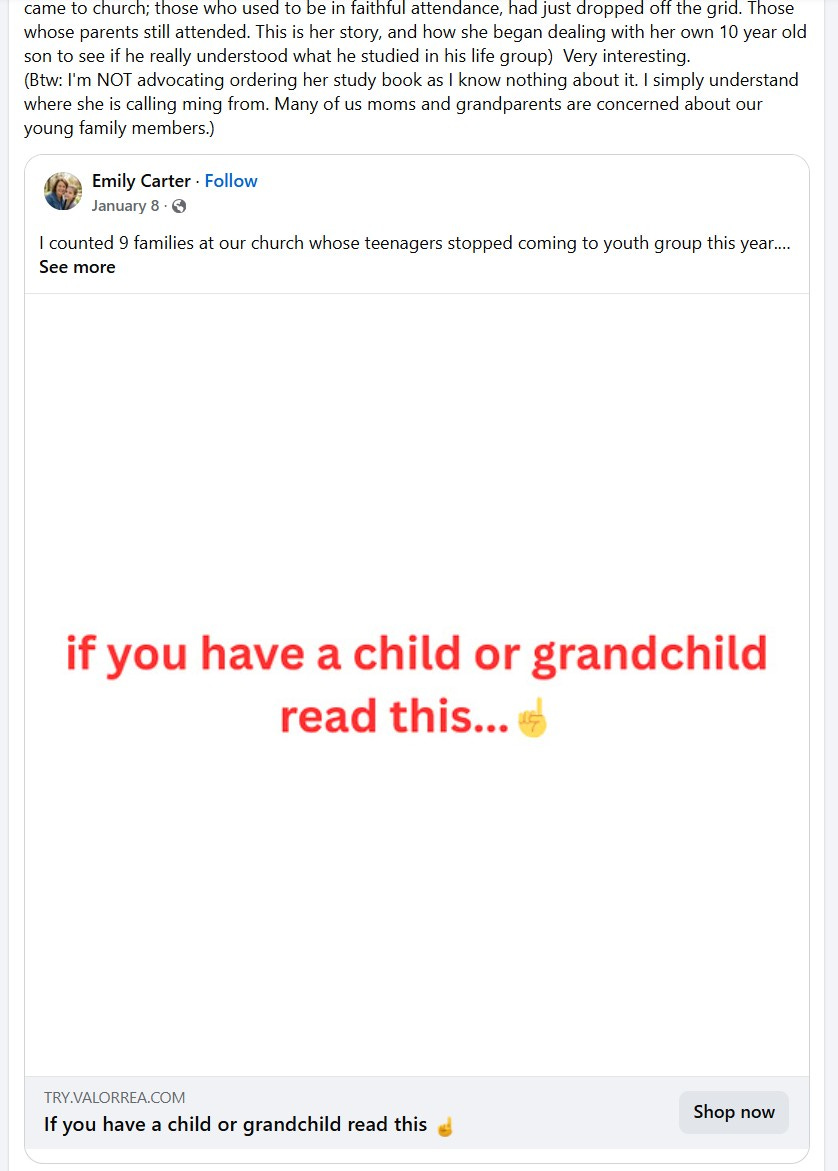
In my folder of evidence and notes—because yes, ever since the pipeline protest, this is how I function now—I outlined what I’d found.
The posts in question all seemed to hit between about Christmas 2025 to mid/late January.3 This was the peak push on Facebook, it seemed. Emily Carter only needed to post a handful of times; once she tapped into the fear parents and grandparents have that their offspring will abandon their Christian faith in today’s culture—once it went viral—posts linking to the Valorrea website were shared by other users on Facebook.
Here is the list I came up with, but I only did a little digging. It is likely there are hundreds more that I didn’t find simply due to time constraints.
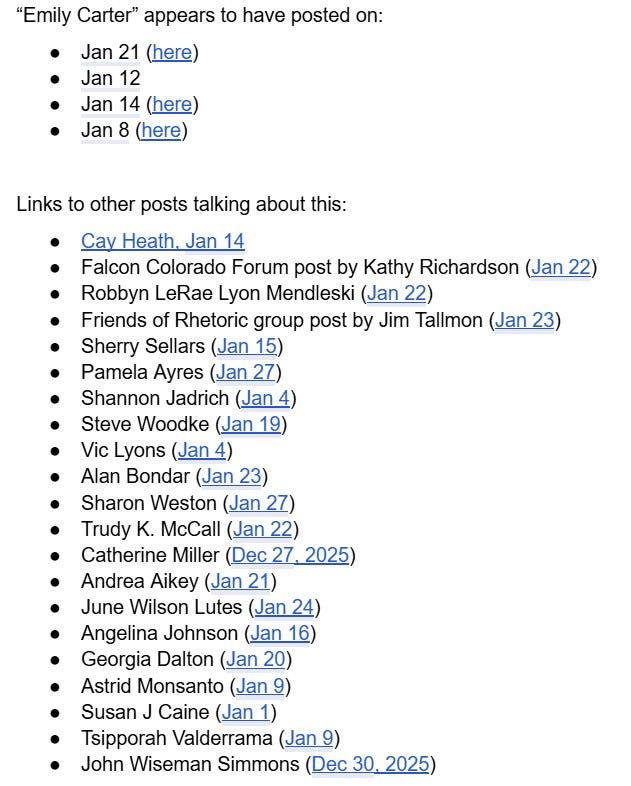
You should still be able to find these yourself, unless the person has wisely pulled them down. Let me be clear: I don’t blame these people. These were convincing, well-written narratives, and every person I saw who shared them did so out of clear concern and good intentions, as evidenced by their comments.
But I hope they, and you, take notes on being careful about what we share. I hope they delete these posts. We have a responsibility to vet the sources and to be accountable if we pass on poor information.
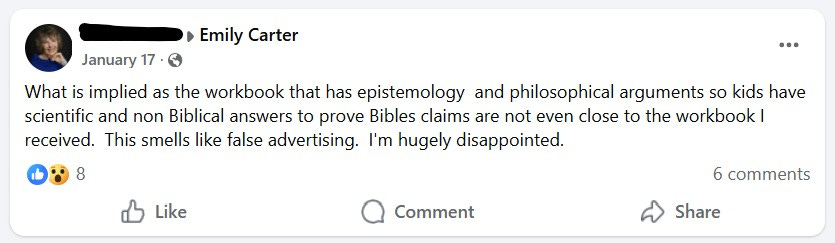
Emily Carter seemed to have a real profile picture and a phone number anyone could call, but was a community center, not a person? Had no other activity outside of the viral window when this was blowing up on Facebook? Even without much digging, it was clearly suspect. It’s within our power to evaluate such things without advanced degrees or tools.
So What’s The Takeaway?
I debated even following up on this, to be honest.
It’s always a headache to write such things because you’re only going to get attacked in this manner.
I don’t believe I ever called Valorrea a straight-up scam, but I mentioned them in a broader blog post about being cautious to avoid online scams and how to evaluate suspect websites; I offered cautions and provided evidence for why I, personally, would proceed with caution. I tried to show readers how to evaluate social media experiences that prompt them to make a purchase. I did not initially disclose that my parents’ bank had flagged Valorrea’s website as potentially fraudulent because I wasn’t looking to badmouth a company so boldly as to acknowledge that a financial institution wouldn’t allow a charge to go through.
My wish?
That Valorrea would produce a truly useful book, fully their own creation, that would actually address the concerns they raised on Facebook: a book appropriate for youth and teens that would teach them what they believed and why.
This would be more about apologetics than systematic theology, in my opinion.4 The two are not the same, though we certainly have a glut of Christians of all ages who could benefit not only from knowing what they believe (systematic theology) but also from understanding why it can be believed (apologetics). I took Systematic Theology in college (“Sys Theo”), and the book I’ve seen in the video is neither systematic theology nor even what I’d call apologetics. It’s more of a Bible story workbook, which is fine if that’s what you want, but it doesn’t really address the concerns raised in the viral blog posts.
I would also warn them that if, at any point, scheming or deceitful behavior was attached to the name of Christ to make a buck, God saw it, and they’ll answer for it. Who cares about my little blog; you’d better repent before God.
The initial email from Yordan had this list of demands:
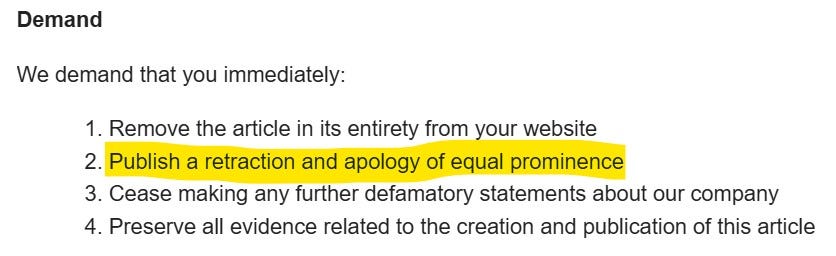
As noted, I never received any information from Yordan regarding the questions and proof I’d need to refute the claims he’d made against the post, which would be the foundation for such a retraction. But I’m fine with doing this follow-up—with the above information showing you my attempt to verify the accusations—in equal prominence by publishing it here on this blog.
If he provides answers to my questions, I will happily update again. I’m not looking to destroy, only to bring clarity. If there are reasonable explanations for all of these anomalies, I am happy to share them.
What Can You Do?
Every year, the FTC celebrates National Consumer Protection Week with information and tips to help consumers avoid falling prey to scams, unscrupulous experiences, or even just how to evaluate products and vendors based on their own comfort level. Consider visiting their website and signing up for some of the resources and opportunities; they have a ton of tips and options.
In the meantime, you can dive into apologetics on Frank Turek’s website, much of it for free. Turek was there with Charlie Kirk the day he was killed, and he worked with Charlie to have explanations for the Christian faith.
Regarding systematic theology, this is tougher. One of the things I love about the Assemblies of God denomination is that they build systematic theology into their materials, but I don’t know what other denominations do.5 I don’t want to leave you with nothing, nor do I want to profit off of this, so I combined the worksheets I’d created for my family and close friends for an online Bible study last fall and am giving you free access. This is only for your personal use, and not to be otherwise copied, resold, or distributed.
If you’re looking for a workbook for younger kids, I’m going to point you to the book I mentioned in the first post.6
A scam can be many things. It can be outright fraud. It can be, according to the Cambridge online dictionary, a “dishonest plan for making money or getting an advantage, especially one that involves tricking people.” A scam is not limited to someone taking your money and failing to deliver a product, nor is it limited to something that is illegal. It might also, based on this definition, include a person feeling as if they were somehow tricked into buying or taken advantage of. It might be someone getting a product that’s different from what they thought they were buying. It might be someone realizing they bought something stolen. It might be feeling that they were emotionally manipulated into spending money on something that didn’t deliver what it said it would. It could be a lot of things. Keep that in mind.
A friend informed me that Whiteriver, Arizona,
is on the Fort Apache Indian Reservation and is the administrative seat of the White Mountain Apache Tribe. The tribe owns all homes there, and you are only allowed one if you’re a tribal member. I highly doubt whitey AI grandma Emily the Community Center lives there.
However, the shipping screenshot I was sent showed December 1 as part of the sales, so it has been ongoing since then, at least.
Systematic theology starts with the Bible as the sole authority for Christian belief, and then uses it to understand those core beliefs. It organizes these doctrines into a clear structure, which is why it’s called “systematic.” This structure might be:
The nature of God
The nature and authority of scripture (bibliology)
The nature of humanity (anthropology)
The doctrine of sin (hamartiology)
The doctrine of salvation (soteriology)
The nature and mission of the Church (ecclesiology)
The study of last things (eschatology)
A lot of people like Wayne Gruden’s Systematic Theology. I don’t. I prefer, if you have no other resources, Charles C. Ryrie’s Basic Theology. Ryrie is not Pentecostal, obviously. For that, you could try Wolfgang Vondey’s Pentecostal Theology, though I have not read it myself. Even better, though, is simply taking the list above and finding trusted teachers who teach on these things freely online.
For example, Junior Bible Quiz is essentially systematic theology for youth, presented in a quiz format. Adult Sunday School systematically works through the entire Bible in seven years. The 16 fundamental beliefs systematically go through the core theology of the Bible for every believer; this is what I taught last fall to a private group of family and friends. Admittedly, I can’t speak for the denomination’s modernized materials, whether they still do this, or whether every A/G church uses them in this way.
Other denominations teach children their theology in confirmation classes and so on, but once they are confirmed, that’s it. Many churches are non-denominational or are part of denominations that have been stripping away specifics from their statements of belief to avoid offending or upsetting people. I’ve come to realize that there are a lot of people going to church who have no idea what Christians believe, what the church they’re going to believes, and frankly, what they believe. Clearly there’s a concern that youth aren’t being well-rooted in their faith; that is why the posts for the book went viral.
The topic’s virality didn’t go unnoticed; currently, there is a glut of books on Amazon for a “52-week systematic theology book for kids” search, and, to be blunt, they appeared within days. I have no idea the quality of the books, and it may be that authors repackaged legitimate workbooks with a new title that captures a viral trend, but just know that AI slop and knockoffs on Amazon are a raging problem. As a writer, I know it takes more than a few days to create a solid, thoughtful, and carefully crafted book that handles something as important as the Christian faith for young people.
Julie,
Thanks so much for debunking this sketchy, Facebook-driven operation! As a dyed-in-the-wool Presbyterian whose tradition perennially out-punches its weight in terms of systematic theology and apologetics (B.B. Warfield, J. Gresham Machen, Cornelius Van Til, Francis Schaeffer, R.C. Sproul, etc.), I was still almost taken in by the *concept* that is quite valid in itself, that today’s kids and grandkids are not being grounded in the “whys” of what they’re taught in Sunday School class.
Most telling in your meticulously researched (even by Presbyterian standards!) was the video that showed a Sunday School Bible lesson booklet masquerading as a book on systematic theology. What’s troublesome to me is the provenance of even the “fine” material constituting that book. In the second of the two videos you shared, the topics could be read at the top of the page, but the body copy was of insufficient resolution to be made out or read. The question of copyright is the derivative nature of the material and appropriate credit or citation attributed to an actual, personal author. The first clue is the attribution of the authorship on the cover, “by Valorrea.” Big red flag there.
But perhaps more bewildering still is the question, who does this kind of thing? Who knows enough about the concerns of American Evangelical parents and grandparents to try to pull off this kind of caper? And besides the obvious profit motive, to what end? If this were some scammer in Romania, how could such a person convincingly pose as an American Christian grandma on Facebook—and why would they even want to?
Perhaps the argument being made by “Emily Carter,” whomever she may or may not be, could be presented to several forward-looking Christian publishers who might have the capacity to produce such a volume; Zondervan comes to mind; Cook Communications, Navpress, or The Gospel Coalition, perhaps in collaboration or cooperation with the Association of Christian Schools. (Many others I’m surely leaving out, including the Southern Baptist’s’ Holman Press, as well as the go-to Thomas Nelson). I would at least be somewhat concerned about denominational skew—you and I would apparently disagree on charismatic doctrine or dispensationalism, probably, but in many instances these distinctives do not negate or outweigh our core areas of agreement—and sometimes would be helpful simply to accurately list or run down the varying viewpoints, presenting them fairly, perhaps in footnotes. A lot of what we’re talking about is in contrast with a secular, atheist/agnostic perspective anyway.
Your thoughts?