
If you're looking for a 52 Week Systematic Theology Book for Kids, be careful where you purchase from.
What greed, algorithms, AI, and easy-to-build websites have done to online buying.

Please note that, as of February 20, 2026, there is a Part 2 to this post, which includes a free systematic theology worksheet you can download and use.

There’s no end to the greed of scammers and hucksters.
Good people who want their children and grandchildren to have a more robust Christian faith are ending up on a website called Valorrea, a gross word that appears to be a repulsive portmanteau of valor and diarrhea, as if having too much valor was a problem we have ever seen in the human race.
Here’s how it started: a Facebook post told an emotional story about young people who left the Christian faith, and why this was happening: they were taught what to believe rather than why they believed. It ended with the need for a book on systematic theology you could use with your kids to help them better understand their faith. There was enough truth in the story to cause most readers to let down their guard and trust the storyteller. I know; I read it and was compelled to search for the product initially before my distrust kicked in.
A little poison in lots of sugar is still deadly.
A social media post incites some sort of emotional feeling—fear, anger, love, coziness—and you are either hit with a related product in the ads you’re shown (the algorithm is very clever), or you go do an internet search and click on the first results you find and buy. Is it a scam? Manipulation? The worst of marketing? The Temu-ization of the world? Whatever it is, we all fall for it.
So the viral Facebook post is how we arrive at the currently popular search for “52-week systematic theology workbook for kids.”
#1. Top search results don’t mean anything anymore.
Top search results used to be the most relevant. They no longer are (see also: the enshittification of Google search). Google search’s top results are now the least trustworthy option because they are for sale.
As noted, Valorrea is a top search result in Google. They have done an excellent job apparently paying for sponsored listings and also keying in their search engine optimization (SEO) to the “52 week systematic theology workbook for kids” search term everyone is using from that Facebook post. And it’s all working. They pop up first, and we’ve been trained to click the first search results as the best ones.
RULE 1: The first search results are often sponsored, gamed SEO, or AI. They are not the best option. Scroll further and look down the list for actual reputable websites.
#2. What do scam websites say?
ScamAdviser gave Valorrea a fair score, but based primarily on technical registrations. According to their measurements, we can see that valorrea.com was likely safe with a “fair” score. But there were a few red flags for me.
Domain registered only three months prior.
Using cheap domain registrar and fast-build Shopify site
On the Valorrea website itself, we find this as the contact information:
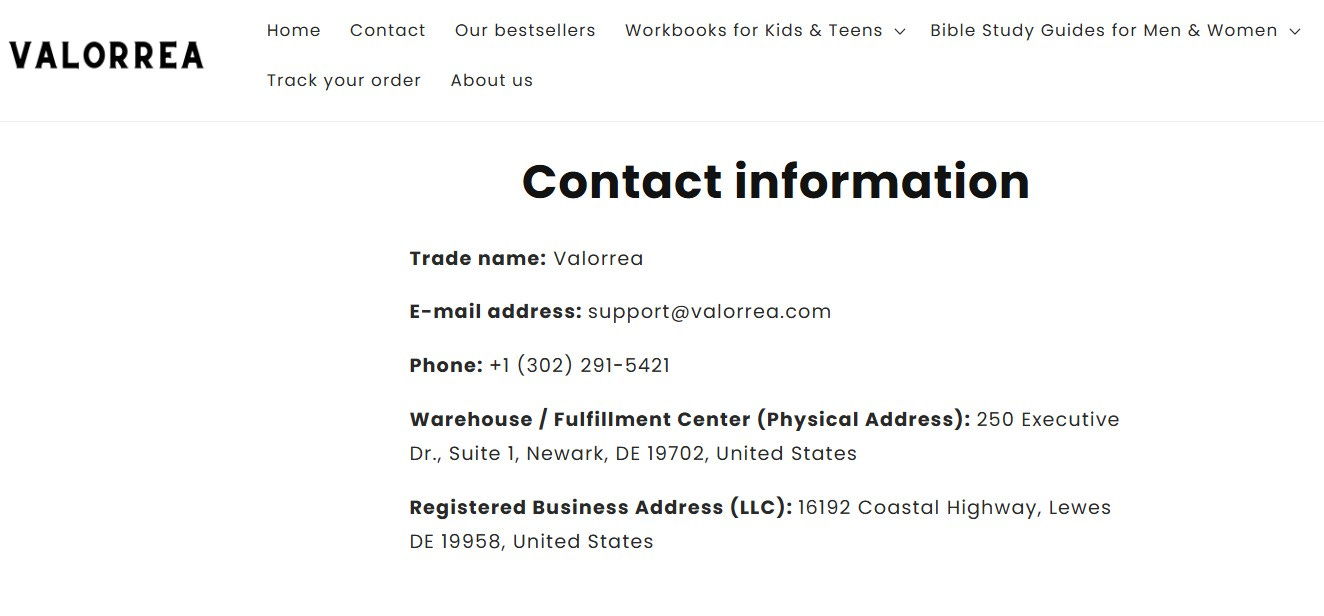
Everyone loves them some Delaware incorporation and association, don’t they, especially them there Suite warehouses.
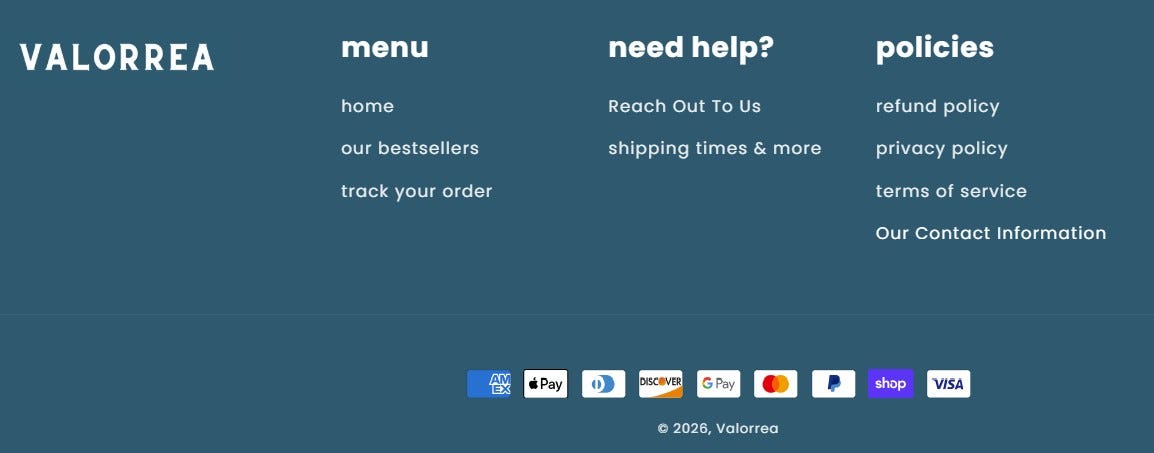
The footer was interesting, a showcase of inconsistencies in capitalization that I take note of and simply add in the “things that make you go hmmm” column:
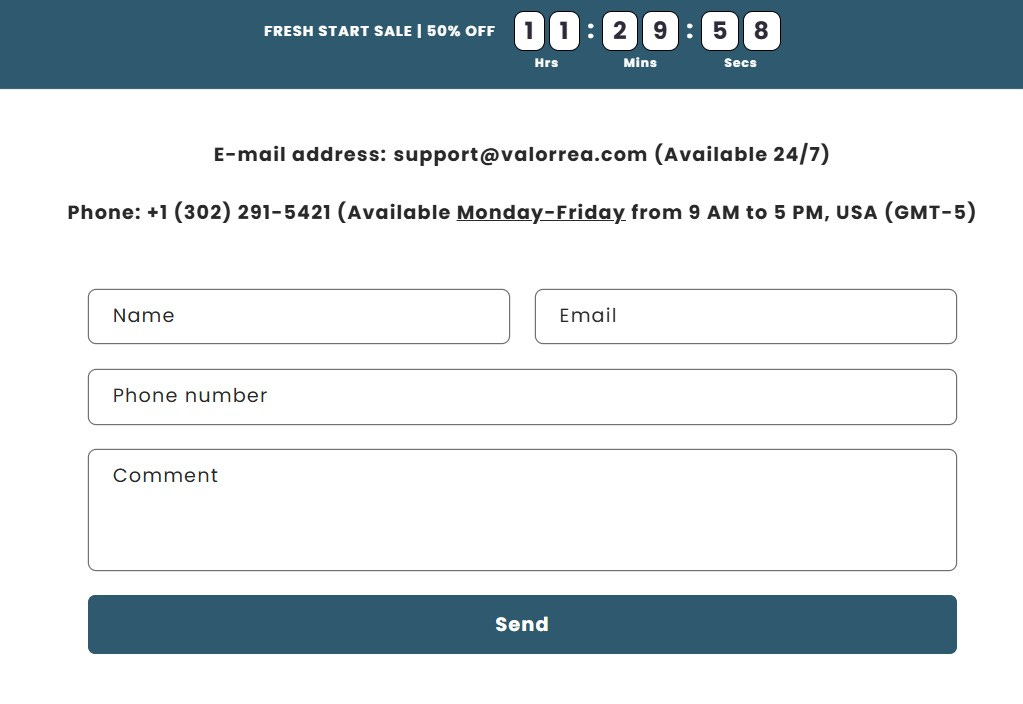
It is also odd for a truly U.S. company to use Greenwich Mean Time instead of the actual time zones found in the US, and add the “+1” to the phone number:
None of this is proof of a scam, but it is unusual. It feels like obfuscation presented as transparency. Malware Tips does a good job of breaking down the Valorrea site, explaining in detail how these online pop-up junk shops rake in money and then disappear.
Products delivered won’t look like they do in the ad.
Few of the “money-back” promises will be kept.
It takes a long time to get the product.
There is pressure and urgency to purchase now for steep discounts.
Making a purchase under some kind of pressure, whether it’s time or emotional, is always a terrible idea.
RULE 2: Look at the website and take note of anything that seems unusual or gives you pause.
#3. What do other people say?
You can’t rely on reviews on a website, as they are controlled and can be faked or paid for. You can’t even trust reviews on social media posts because of bots and other fakery.
Valorrea has what appear to be Facebook testimonials. I searched several of the names and found Facebook accounts that match. What could that possibly mean?
The real person reviewed the book that they bought through Valorrea and liked it.
Valorrea created fake reviews and scraped real account names and profile images to do so.
Some people had good reviews, some bad, and Valorrea only showed you the good reviews.
The best reviews are those on other platforms that the seller cannot control. I often go to Reddit to see what others are saying, and I was not disappointed. I found the thread “Valorrea Bible study guide is it worth buying or misleading product?”
We’re going to get into the real guts of what that Reddit thread contained, but for now, let’s give the benefit of the doubt and say that people giving reviews that the book was great were real. I’ve no doubt the book they might have received from Valorrea may indeed be excellent in its content, if that’s actually the book you get. And that’s where this gets really interesting.
The apparent theft of intellectual property.
The theft of intellectual property (IP) by other nations is rampant. I don’t know that much can be done, except that we stop buying fakes and knock-offs, or lose our minds with cheap prices.
So let me introduce you to Jenny Ingram, who wrote Bible Study Workbook for Kids back in 2024. It’s a beautiful book, with thoughtful illustrations and great content.
Valorrea, from what I can tell in the screenshots I took on the morning of January 5, 2026, took Ingram’s copy and apparently used AI to generate the illustrations, reselling it to fit the new 52-week systematic theology workbook for kids hype.
Previously, based on the Reddit thread I mentioned earlier, they seemingly had called it the same thing Jenny had but recently adjusted it to slap the “systematic theology” title on the cover to tap into the viral post.


After gathering these screenshots and discussing them with others, I later started seeing the Valorrea ads on Instagram. It was worth noting that the Instagram account was only three months old, had two obligatory Jesus-y but product-irrelevant posts, and was based in Bulgaria.


Out of curiosity, I clicked through the ad. There, I found a landing page just for Instagram users that told a very similar story to the viral Facebook post. The story uses what seem to be real people’s names, real statistics, and real scientific research. It seems verifiable (but isn’t, really). It’s the perfect mix of what I, as a writer, would use to persuade: personal story, shocking data and dilemma, the quest for a solution, and the solution presented as a call to action (buy this book).


But this time, scrolling the Instagram version of the site on the evening of January 5, 2026, I realized something seemed different about the webpage. I went to my computer to see it on a larger screen. When I clicked through, I was surprised to see that the images displayed had changed. In just half a day, the book for sale had changed.


This is not the first time the website has quickly changed something about the product. In the previously mentioned Reddit thread, a user had seen the book with an entirely different title (they had used Ingram’s title at one point):
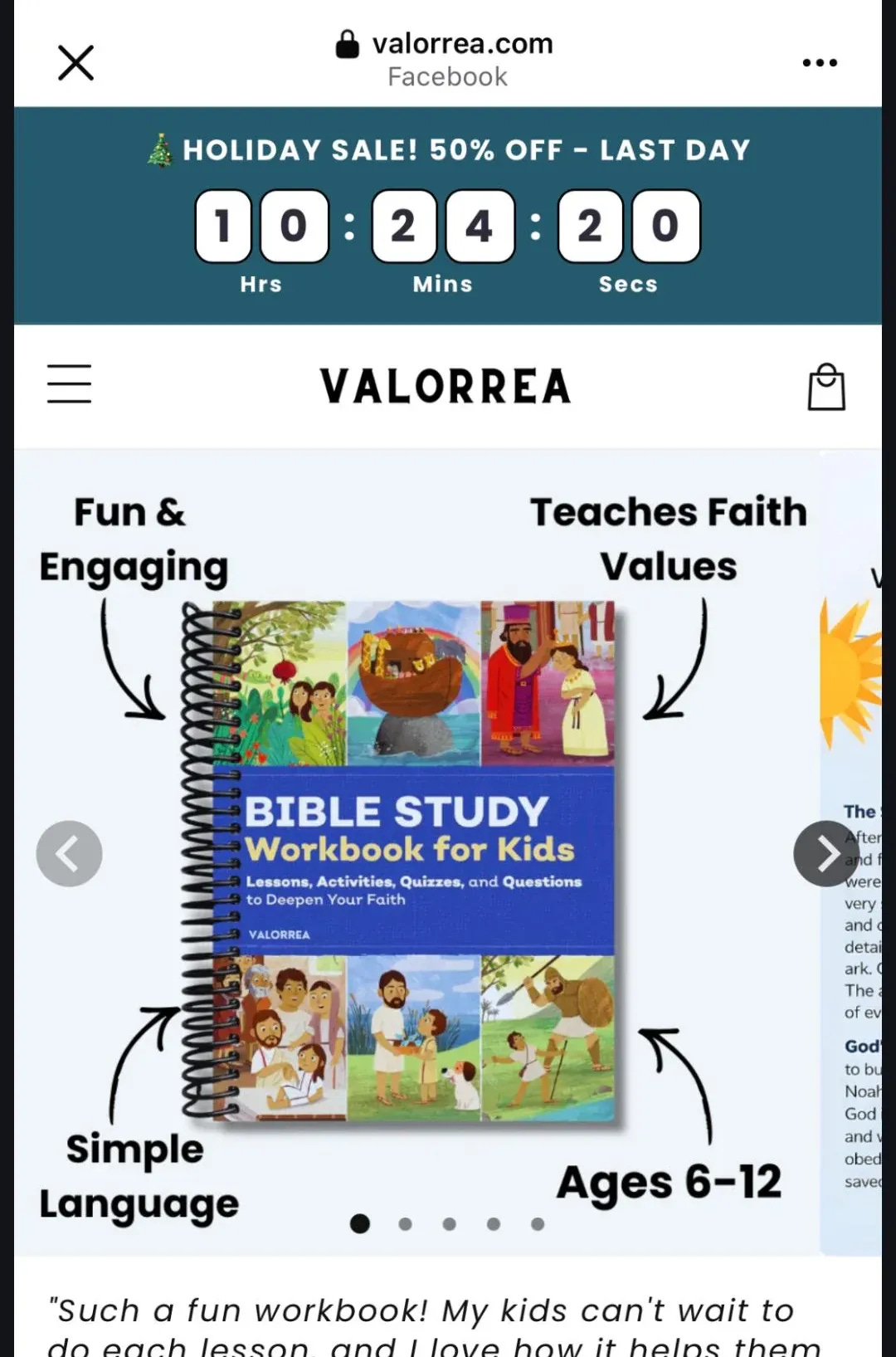
It is my opinion that this is a shady website that quickly changes product details to match the keywords bringing people to its page, to deflect accusations of IP theft, or to make the biggest buck before it disappears. It could be what we call A/B testing, where you test many options to determine which performs best and generates the most revenue. The images and text that generate the most money get to stay.
If you order this book, I have no idea what you’re going to get, what it will look like, what copy they’ll actually be using—and neither do you. But if you actually want a Christian workbook for kids, you can buy Ingram’s book through reputable websites without any sketchy concerns, and support a legitimate author who deserves your support.
The takeaway?
Scammers now have AI, aggressive algorithms, and pure greed working for them. They can identify real pain points and the problems we want solved. Compassionate and sincere but gullible people are an excellent target. There is a reason we must be shrewd as snakes and innocent as doves (Matthew 10:16).
Christians are an easy target.
Most of the heartwarming stories we see on social media aren’t true. If you enjoy them, enjoy them as fiction. If you can identify the bits of truth woven in, don’t buy the product you’re pushed to get. Instead, consider the truth and what action God would have you take. Go to trusted websites first to see if the product is listed.
Because these scammers are really, really good at what they do. They’ve gotten me a time or two.
Please read the follow-up to this blog post, in which I respond to Valorrea demanding I take this blog post down.
I hate marketing. I find it so destructive. Tear down a person with fear, guilt, shame, etc., and then stick them with the sell and get their money. Feels ungodly at the very least.
Wow, Julie, you put some work into this! Great research. Amazon’s print-on-demand does seem to mean that the same basic book could be tailored to 75 different audiences, with different covers, and even contents, for different demographics responding to varying advertisements.
About those advertisements, you write that
“I clicked through the ad. There, I found a landing page just for Instagram users that told a very similar story to the viral Facebook post. The story uses what seem to be real people's names, real statistics, and real scientific research. It seems verifiable (but isn't, really). It's the perfect mix of what I, as a writer, would use to persuade: personal story, shocking data and dilemma, the quest for a solution, and the solution presented as a call to action (buy this book).”
Well!
In the 1999 worldview guide How Now Shall We Live, a collaboration between Chuck Colson, Nancy Pearcey, with help from Harold Fickett, we learn that
“[R]eligions and philosophies are not the only ones offering redemption. any belief system in the marketplace of ideas…anything that has the power to grab people's hearts and win their allegiance does so because it taps into their deepest longings. and those longings are, ultimately, religious…
“According to sociologist James Twitchell, in his book AdcultUSA, many of America's early advertisers were Christians, often sons of clergymen. As they developed the art of modern advertising, they simply translated their understanding of spiritual need into the commercial arena. The spiritual sequence of sin-guilt-redemption became the psychological sequence of problem-anxiety-resolution. That’s why the typical television commercial is, in Twitchell's words, 'a morality play for our time'. We see a man or woman in distress. He has a headache; she has a cold. a second figure appears on the screen promising relief, testifying to the power of the product being advertised. The seeker tries the product and, hallelujah, the problem is solved. Life is blissful. From on high, the disembodied voice of an announcer presses home the advantages of the product. 'The powerful allure of religion and advertising is the same, Twitchell concludes. both reassure us that 'we will be rescued…”
🤔