
Blue Like A River: Dude, it was like Game of Thrones.
The miracle blizzard that stopped the veterans' movement to fight the Morton County Sheriff's Department.


“Most civilians who’ve never served in a uniform are gutless worms who’ve never been in a fight in their life. So if we don’t stop it, who will?” — Wesley Clark, Jr., Task and Purpose website, Nov. 21, 2016
“They think this is Avatar,” I said while talking to a documentary filmmaker after the protest was over. Avatar was a film about a planet whose indigenous inhabitants were being wiped out by a mining company with quasi-military security forces. “They think they’re living a movie.”
If a comparison must be made, the protest was more like Lord of the Flies.
Throughout the ordeal, protesters compared themselves to the movie Star Wars, suggesting that the small Morton County law enforcement contingent was the equivalent of the Imperial Forces. They referenced themselves as being in The Lord of the Rings or X-Men. They had actor Mark Ruffalo as a supporter, and, since he played the Incredible Hulk, he was going to “smash” Morton County.
Even actress and protester Shailene Woodley, in a September 1, 2017, interview in Marie Claire, seemed lost from reality as she described a day from her stay at the protest, when she was “walking to her RV for lunch when she spotted two US military tanks. ‘I’m like, “This is some Divergent shit,”’ she recalls, referencing the post-apocalyptic trilogy she’s best known for. “The only time in my life that I saw a tank like that was on set in Atlanta.’” (There were no tanks at the protest.)
After her arrest and exit from North Dakota, Woodley turned off her cell phone for three months “due to the post-traumatic stress disorder symptoms she and her friends were experiencing post-Standing Rock. ‘There was so much trauma,’ she explains.”1 She did not explain why she didn’t come back in February to clean up the huge mess the protest left behind. People take their trauma with them, but leave their trash behind. I’ll never understand it.
This is some Divergent shit. The Incredible Hulk will smash Morton County. Stormtroopers were running amok. Somewhere in Mandan is Barad-dûr, the tall, dark tower where evil Sheriff Sauron lurked and called in lunch orders for Jim and Joe and Bob and Becky out on the front lines down on Backwater Bridge.
It’d be nice if I could say this fiction-reality problem was only for the “lower ranks”, but then there’s the case of Wesley Clark, Jr.
I wondered if we’d reached peak hyperbole when Clark smirked across the North Dakota state line at the start of December 2016. When I first read the quote you see at the start of this article, I wasn’t sure whether I took him seriously. It seemed more like a bastardized John Wayne quote, or something you’d hear in The Dirty Dozen.
Clark is the son of a famous general. Online, I saw some veterans making jokes about cavalry scouts and Clark, but since I’m not in the military, that particular joke is lost on me.
It seems, based on what I read in the Task and Purpose article Clark’s opening quote is from, and also in how Clark responded to comments there, that he felt that Jesus wanted him to create Veterans Stand for Standing Rock (VSSR), raise more than a million dollars with his buddy Michael Wood, Jr. (a former Marine and Baltimore police officer who had come out in support of the Black Lives Matter movement), bring thousands of veterans to the wintry plains of North Dakota, get some photo ops, and head back to the studios of The Young Turks Network to talk about how wonderful and renewed he felt for doing all of it.2
That’s not exactly how it was described, of course, but that’s how it was. Apparently, you can’t do the work of Jesus without a lot of fanfare.
The Task and Purpose article was entitled “Where Evil Resides: Veterans ‘Deploy’ To Standing Rock To Engage The Enemy—The US Government.”
I don’t know if anyone else laughed at that title, but I found it ironic, considering that part of the problem was that the federal government, under the Obama Administration, was sitting in Washington, eating popcorn and watching it “play out.” It would be difficult to engage the federal government, since it wasn’t actually there. A more accurate headline would have been “These Two Guys Love Themselves, And Are Dying For A Photo Op Near Concertina Wire and Eagle Feathers.”
My guess is that the Task and Purpose headline was some kind of dog whistle for people angry about the recent presidential election of Donald Trump, in which the whole world was apparently in a fetal position and desperate to figure out a way to exist and resist. The thought of having a bunch of disgruntled or badly-informed veterans head to the plains of North Dakota to fight against a small state and county’s very decent law enforcement made for great clickbait.
Once you got past the misleading headline, however, the article made it clear that North Dakota law enforcement was the real enemy. This was supported by the many news articles written about the mobilization, in which, for example, a veteran named Matthew Crane referred to North Dakota law enforcement as a “domestic enemy.”3
The articles that reported on this veteran deployment were full of the standard stock narrative with stock characters, just like a predictable movie. There were the usual suspects who were always happy to talk to reporters, telling of how they were saving the world for future generations and the public was being repressed and the police were in direct cahoots with private security and this was practically Selma and that they were trying to save the U.S. Constitution. Noticeably absent was any discussion about the rights and concerns of the landowners and community around the protest, who also had a vested interest in the U.S. Constitution.
A story about Clark practically writes itself. Check out this beauty that Clark spoke forth in the Task and Purpose article: “The impending confrontation at Standing Rock, [Clark] says, will be ‘the most important event up to this time in human history.’”
Ye gads.
Clark isn’t the only one with money quotes in that article, however. In talking about the event’s “clearly defined goals,” Wood said that “one of the issues the police are going to face is that our level of planning and coordination is vastly superior to theirs, so they may end up with a problem when it comes to that.”
Let me tell you about that vastly superior level of coordination.
It starts with the mockery of older veterans in North Dakota. Thanks to Wood and Clark and their depiction of the protest and the people and law enforcement in this state, protest supporters were emboldened by VSSR to go Morton County Sheriff’s Department Facebook page to taunt them about the thousands and thousands of veterans from around the country who were going to come up and “whoop their ass.”
Not surprisingly, North Dakota veterans organizations did not want VSSR to come to the state and further escalate tensions. By this time, you see, the online rhetoric had turned increasingly violent, and Frank Arrow told me he’d heard chatter about the nature of some of the people coming and what their intentions were. “They want to see bodies in the snow,” he said. “Another Wounded Knee. They want that visual.”
Twice I’d read worried comments in private groups, and then later heard Sheriff Laney reiterate it in a press conference: some veterans with PTSD were going to be manipulated into violence. In the online community groups, tension and fear were high that someone was going to get hurt or killed.
I hope that Clark, in all of his 100-percent nonviolent, woke-dude-bro joy, appreciates what he created in North Dakota during those few weeks of Thanksgiving and into December, while he was receiving the world’s accolades for his bravery. Not only were there escalations in violent confrontations at the protest camp and also in the cities of Bismarck and Mandan, but now the specter of potential deadly violence and thousands of angry veterans facing off against a small North Dakota law enforcement force and our North Dakota National Guard was dumped on top of that.
Given all of this, it’s logical that North Dakota veterans groups issued a statement explaining why they did not support VSSR. In that statement, they said that “slaughtering privately owned livestock, throwing Molotov cocktails, and assaulting law enforcement officers is not the military manner in which our veterans behave.” They respectfully asked VSSR not to come to North Dakota.
How did VSSR respond? How did their supporters and the protesters respond?
VSSR ignored the request of these veterans, many of whom were older (i.e., elders) and had seen action in Vietnam, Korea, and the Gulf Wars.
On November 27, 2016, just days after the protesters had marched through Bismarck and Mandan with a pig head on a stick, VSSR representative Keith Gibbs sent out a statement to North Dakota veterans groups asking these elder veterans not to interfere with what VSSR was planning, and to remove public posts stating that they didn’t support VSSR. If these elder veterans had concerns, the letter said, they could just bring them to VSSR and let VSSR talk to them. The letter concluded by saying that if they couldn’t stand with VSSR, it was preferable that they didn’t publicly stand against them.
The letter was incredibly arrogant and patronizing, shushing these local veterans because VSSR thought they knew best. It was a kind of replay of what had happened to Standing Rock when some of the elders and eventually the tribal council had asked the protesters to leave. “Shush, doggies. We know best. Just sit down and let us more advanced and educated urban outsiders tell you how it ought to be done.”
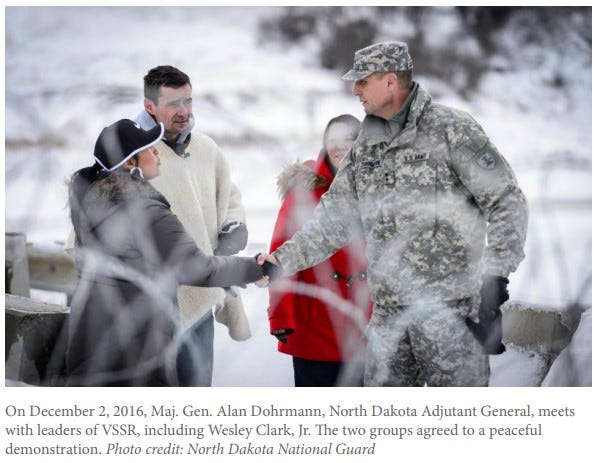
This led to online protest supporters feeling even more emboldened; they responded by mocking these older veterans on social media, making jokes about nursing homes and fat racists and drooling old people. It was the most sickening and disrespectful display I’d ever seen. The protest supporters accused North Dakota veterans of asking other veterans not to exercise freedom of speech. But remember, VSSR had done the same thing to North Dakota veterans by asking them, in the letter, to shut up and stay out of it.
I can tell you that as a member of the community, in the days leading up to the December 4, 2016 official arrival of VSSR, I saw in others—and felt it myself—a kind of blistering anger as well as fear that our law enforcement (many of whom were veterans) and National Guard were going to be involved in a deadly confrontation.
But people in the community were also paying attention to the weather forecast, as North Dakotans religiously do, and a potential blizzard was in the works.
I’ll take a guess and boldly say that never before in the history of the state have so many people prayed for a blizzard to arrive, fierce and mighty. I called friends and family, sent out emails, and asked them to pray for a blizzard to literally cool off the protest situation that was set to explode with the arrival of veterans.
Our prayers were answered.
I’m not joking, and I’m not alone in this opinion.
Repeatedly, in my interviews and conversations about this protest, people said that the first December blizzard was an answer to prayer. “That blizzard saved lives,” one woman told me. “It saved the lives of protesters and law enforcement. It was a godsend.”
On December 4, 2016, the day the veterans began arriving, and the day the Obama Administration decided to refuse the final permit for the pipeline, we started to get some snow.
The snow came. Slowly at first, in big, thick flakes.
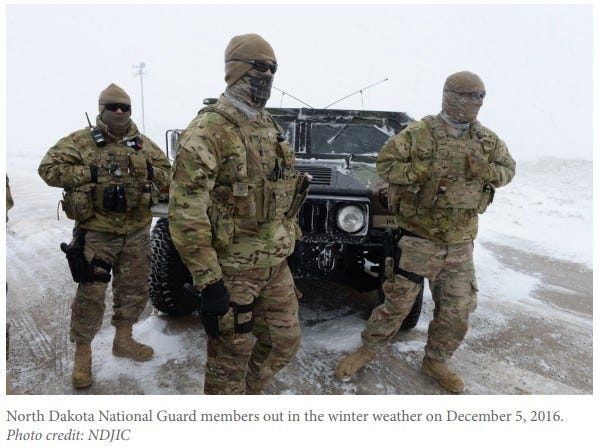
As the hours wore on, we got snow on snow.4 The blizzard wasn’t exactly one for the North Dakota record books, but for anyone not from here, I imagine it was terrifying.
The protesters weren’t used to a Great Plains blizzard. They didn’t know about things like headbolt heaters, keeping emergency survival kits in your car in case you were stranded, and not using water as a coolant. They took to social media to suggest that Morton County wasn’t responding quickly enough to people who slid into the ditch or needed assistance; some suggested the county and state were deliberately not running plows in the heart of the blizzard to keep the roads closed. There were car accidents, some serious, as people who weren’t used to driving in those types of conditions went off the road or had collisions.
Christopher S. Duesing, with VSSR, asked his Facebook followers to contact the North Dakota National Guard and the governor’s office (posting the phone numbers) to tell them to clear and salt the roads before the situation became a humanitarian crisis. If you live here, you know that in the thick of a bad blizzard, nearly everything stops (and also, it’s Minnesota that uses road salt).
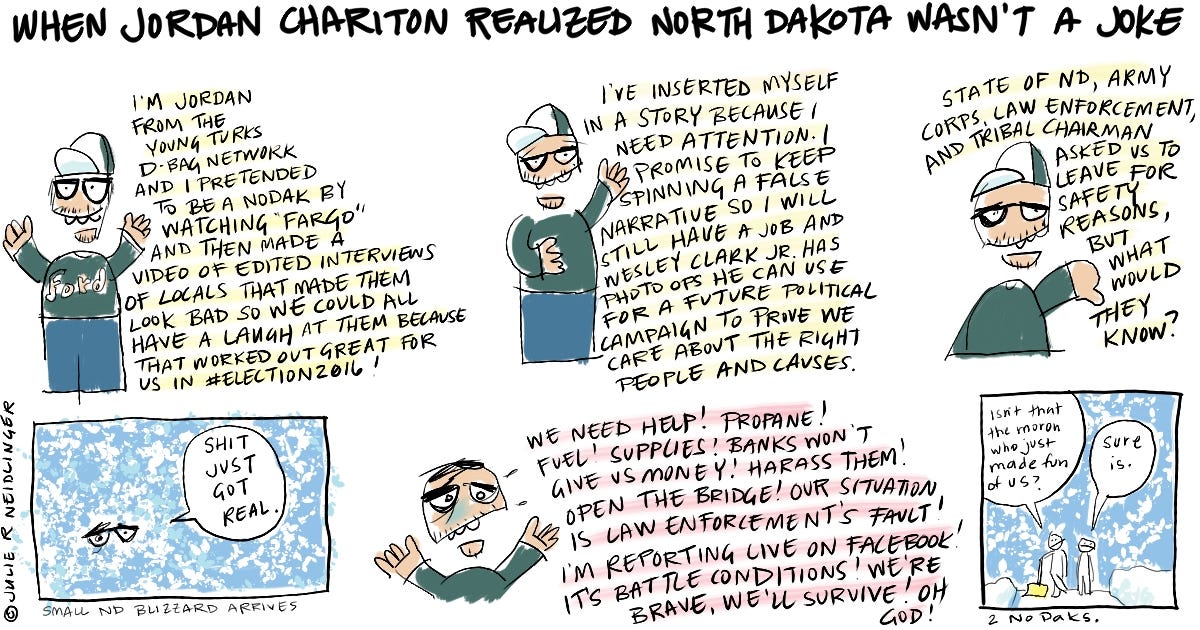
North Dakota officials had warned the protesters, in the days leading up to the blizzard, to leave the camp before it arrived. The state had previously set up a special radio channel that simply broadcast winter survival information. There was a reason the state set up two emergency shelters in schools for the protesters to go to. But because North Dakota and Morton County were so “evil” in the eyes of the protesters, nothing they said could be trusted. It was all a trap, a trick. Yet when the snow came, suddenly they needed help.
I’ll admit, after seeing how some of them were trying to spin the blizzard response as another bad thing we’d done to them, that I thought, hey, if water is life, here’s lots of it, in its solid form. Enjoy.
But that’s unkind, and I certainly didn’t want anyone to freeze or lose their fingers or toes from the cold. Yet, while all this wintery business was starting, where was the leader? That’s literally the million-dollar question.
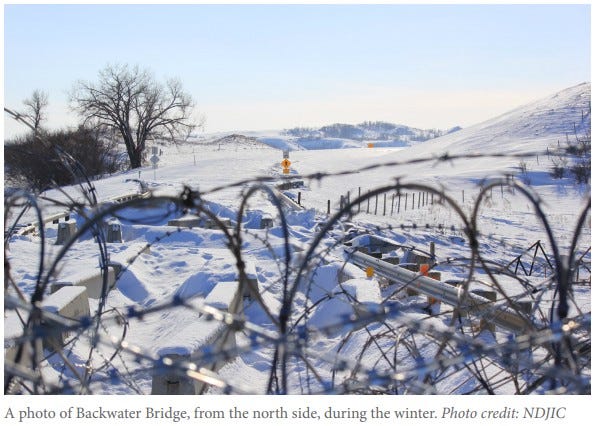
There was a meeting between Clark and law enforcement in which Clark took responsibility for the protesters, and law enforcement agreed to move back from the line on Backwater Bridge if Clark promised the protesters wouldn’t be on the bridge. He promised. Law enforcement moved back. Clark failed to keep his promise. There were groups of veterans on that bridge. Had Clark kept his word or actually been in charge, they shouldn’t have been. That was the first inkling that things weren’t going well.
As the storm worsened, protesters and veterans began to post to Facebook that they were sleeping in the halls of the Prairie Knights casino, on Standing Rock, or that they’d been abandoned in the camp. There was no food or assistance. Photos of blown-down tents, snow-filled mess tents, veterans huddled in fatigues and gas masks in sagging tents, and general chaos emerged on social media.
The casino quickly filled up, far beyond the rooms available, and complaints began to emerge that Clark and Wood had abandoned them. VSSR had raised over $1 million through GoFundMe, and it seems that the veterans who came had expected that money to be used for adequate food and shelter. The veterans began demanding to know where that money was, why there was nothing for them to eat, whether they would be reimbursed for their travel, and whether buses or other transportation would be provided to get home.
In some online community groups, a few of us began quietly trying to help a handful of veterans whose family members were concerned because they could not be located. Messages popped up online from people wondering where their son or daughter was, and it was distressing to see.
A woman named Diane posted about needing help on the Facebook page “Truckers for Standing Rock.” She described the humanitarian need of abandoned veterans scrambling for a place to go. What caught my eye was this comment: “The VSSR page is asking people to contact North Dakota National Guard to help evac vets…”
Would this be the same National Guard that VSSR came here to deploy against, that domestic enemy that they were, only a week earlier, so gleeful about facing down?
The blizzard continued to rage. Cars continued to hit the ditch. Highway Patrol and other emergency services responded as best they could.
I, like most other North Dakotans, was hunkered down at home, having prepared for a few days of being snowbound and actually looking forward to it. I scrolled through Facebook and marveled at the chaos and disorganization. In the midst of all these veterans in need, Clark and Company, it seemed, was most intent on an elaborate forgiveness ceremony in which they bowed down before some Standing Rock elders and tearfully asked for forgiveness on behalf of the United States military.
In an interview with EcoWatch, Clark’s forgiveness ceremony was described as “an emotional plea to the tribe for forgiveness by former Army Lt. Wesley Clark Jr., son of Gen. Wesley Clark, former Supreme Allied Commander of NATO.” For the ceremony, Clark bowed before Chief Leonard Crow Dog and other elders, and with photographers and video cameras rolling, said:
“Many of us, me particularly, are from the units that have hurt you over the many years. We came. We fought you. We took your land. We signed treaties that we broke. We stole minerals from your sacred hills. We blasted the faces of our presidents on your sacred mountain. Then we took still more land and then we took your children and...we tried to eliminate your language that God gave you and the the Creator gave you. We didn’t respect you, we polluted your Earth, we’ve hurt you in so many ways but we’ve come to say that we are sorry. We are at your service and we beg for your forgiveness.”
Crow Dog put his hand on Clark’s head, and I guess all was forgiven. But is it that simple?
Native American author Craig Stephen Smith, in his book Whiteman’s Gospel, discusses seeing these types of “reconciliation events” and questioning their validity or purpose.
“Can I assume the privilege of representing complete nations and peoples without that privilege being granted me by the same?”, he wrote, suggesting later that reconciliation is a personal and individual event.5 “I have to deal with the prejudices and ill will that I bear personally to those I know who have offended either me directly, or even to my people, corporately. Repentance and reconciliation then becomes intensely personal.”6
I don’t recall Clark being sent to seek forgiveness as any kind of wholesale delegation on behalf of the U.S. military or citizenry.
I can’t help but see it as an emotional man trying to offload some guilt and an emotional burden, covering it under the guise of seeking forgiveness for millions of people who didn’t ask him to do it. More importantly, now that he had the forgiveness of Standing Rock, what next? Smith rightly wonders what happens in the mind of someone who has received forgiveness in this manner. “Does he feel that now finally, he and his ancestors are completely absolved...and everything is now forgiven and they can now get on with their lives?”
Outside the dramatic forgiveness ceremony, the cold and snow continued to pound on the thousands of veterans who wondered where their leader was. The blizzard had decimated most of the carefully organized deployment plans, but the forgiveness ceremony, with cameras rolling and big tears falling, didn’t miss a beat.
The blizzard ended.
Clark and Wood left.
Most of the veterans were stuck behind, scrambling to figure out how to get home and trying to raise money on their own to do so. Very little of the VSSR GoFundMe money had come through.
Alex Popescu, a veteran who’d joined the VSSR movement, wrote on Clark’s Facebook page that he thought it was “really cool how you guys had all the coverage at your little ceremony while the rest of us marched and froze and were left with zero support at the camp. Your HQ bailed in the middle of the night and we had to help evacuate people and organize supplies to feed and water people. Way cool how Matt saw a group of us at the airport and said he didn’t know when buses were coming then hopped into his EMPTY Yukon and drove off. Way cool how the RTL’s had little information from you two and couldn’t pass much word. Way cool how you chose to stay nice and warm instead of being on the march to the bridge; lead from the front ring a bell? Way cool how nobody is answering questions about people getting reimbursed for the money they spent in this. Way cool how you guys used so many for your PR stunt.”
Kyle J. Kott, also with VSSR, described a photo from the fiasco. “This tent collapsed and caught fire at 3 am with over 20 people in it. Props to our medical team and vets that ran into a blizzard and held it down in the worst possible conditions.”
Another man wrote that his son had traveled to North Dakota for VSSR. He was from North Carolina and was with seven other veterans. “He said the whole organization has completely broken down and the leaders of this event were safe and warm in the casino and have abandoned the 2000+ vets that are there. Also, the million dollars raised to help fund the vets that did come has not been seen while they still continue to beg for donations.”
Mike Petrone, another veteran, stated that VSSR had been “a logistic (sic) nightmare. The vets have been basically used as pawns for media and a horse and pony show.”
Chad Charlie wrote that “this shit is getting out of hand. There is a vet here at camp that had his vehicle stolen with ALL of his winter gear in it. He flew all the way from Dubai to be here and had to borrow his parents car…”
Tony Mora wrote about VSSR, stating that Clark and Wood were nowhere to be found, and that someone who supposedly was a representative from headquarters “stood on a stack of wood shouting meaningless words and would not tell us what if the march intent was to be peaceful or were we to attempt to go beyond the bridge and meet law enforcement resistance.” He said that leaders were not present when they walked forward to the front line (on the bridge). He said that the “Oceti Sakowin camp was never properly prepared to receive those vets” and that people were left to figure out where to find some shelter. He said he began receiving emails from people wondering where their family members were. “I and many who were with me in that camp for three days on the ground among the water protectors know a side of this story that leaves me asking the question what really is behind all of this.”
Kash Jackson recorded a Facebook video while leaving North Dakota, highly irate. “What I want to know is, where is Mr. Clark and the other gentleman who was with him and arranged to have all these people come in? Where were they at, because they weren’t out there on that bridge with me with all those veterans just a couple of days ago. [...] Furthermore, I want to know what was done with all of the money that was donated for all these veterans to come out here? Almost $1 million. What was done with it? Why did we need that kind of money to bring these people out here, for them to sit up there in the casino?”
These scattered messages began to gain momentum as more people demanded answers from Clark and Wood.
It was difficult to piece together exactly what had happened until December 8, 2016, when veteran Bonnie Hoppa posted a lengthy “Standing Rock After Action Report” on her Facebook page. She noted that this was based on her experiences and the firsthand accounts of the team she administratively supported who went to North Dakota, and stated that what she wrote was verifiable through multiple sources. For the next twenty-eight paragraphs, she detailed what seemed like a complete derailment of VSSR.
Hoppa describes initial confusion over communications before even sending a team. “I was concerned,” she wrote, that “in spite of the coordination with the Elders, that White Savior mode was being engaged.” She described the organization as almost non-existent, with “just enough playing Army to get your average Veteran excited...”
According to Hoppa, the funding became an issue when VSSR announced on November 30 that they were having difficulty withdrawing funds from GoFundMe and that people should donate to a Square account. That meant veterans going there had to pay their way and rely on the assumption they’d be reimbursed. Some of Hoppa’s team arrived at the Bismarck airport, but no one picked them up. She described large numbers of groups flying in, and renting vans and U-Hauls to get the people out to the camp. Lack of communication between headquarters at the camp continued, with confusion about whether to go to the camp or not, and missing MREs.
“Meanwhile,” she said, “the ‘leadership’ of VSSR were staying in the casino hotel, and putting on dramatic displays via a ‘Forgiveness Ceremony.’ The GoFundMe had climbed to almost 1.2 million dollars, but we were told that food issues were because M&T Bank was holding the funds raised.7 Personally, I was infuriated to see the half-assed apologies coming from a hotel room, while my people were cold, exhausted, and hungry.”
At about that point in Hoppa’s story, the blizzard had arrived in full. Hoppa said there was no response from VSSR headquarters and that her crew began rescuing stranded veterans in the blizzard. When headquarters finally reached out, it was to tell everyone that all veterans who were not Native American needed to leave Ft. Yates (the small town near the protest camp) immediately, and “were not welcome to move over to the camp.”
The GoFundMe account was still live, still racking up donations, even as all of what Hoppa described unfolded.
It wasn’t long before other protest supporters started demanding where the money went. Staunch protest supporter and photographer Ryan Vizzions (one of several of his nom de plumes) demanded that Wood explain where the money went and that, if he did not, Vizzons would contact his copyright lawyer for VSSR’s use of one of his photographs on their GoFundMe page.
As pressure to explain the disastrous event grew and the hashtag #WheresTheMoneyWes gained popularity, Clark posted a slightly bizarre, rambling explanation for VSSR’s failures. Gone was the cock-of-the-walk swagger he’d had a few weeks earlier, in which he and Wood were so sure North Dakota law enforcement was nothing but a bunch of Keystone Cops who couldn’t compete with the logistical wizardry of VSSR.
“Please accept my apology for the massive logistical problems that occurred at Standing Rock…” Clark wrote on his Facebook page on December 9, 2016. His profile photo showed him holding a Star Wars light saber. He said they did not have the communication or organizational capacity to handle the deployment, but assured people that there would be a full accounting of where the money went. “Our action was successful thanks to the sacrifice and hard work of those who were on the ground before us and endured the risk, pain and suffering when the eyes of the world were not on Standing Rock…”
For the next three paragraphs, he expressed various philosophies on spiritual force, saving the planet, extinction-level events, and the future of children. “Once again, I am sorry for what I am certain are dozens, if not hundreds, of errors in my attempt at leadership. I drank no alcohol and had minimal sleep and food while at Standing Rock. Much of my time and energy was spent in a diplomatic role between the multiple factions and interests without spending enough time with you…”
A few days later, after Clark had left North Dakota behind, a photo appeared on his Facebook page in which he appeared to be in Los Angeles hanging out with a filmmaker (Darren Edwards), a screenwriter (Melissa Emery), and another woman, Haze Lynn. In the comments of that post, Clark responded to a friend, named Jeremiah Zick, who wanted to know what had happened with VSSR.
“Congratulations on what we achieved, Wesley. Here’s hoping we can keep fighting for the natives,” Zick wrote.
“Thanks bro. Sure it was fucked up but we did something good just by getting there. In the end we’ll be fighting for everybody,” Clark responded. Reading that made me snicker. I’ll fight my own battles, thanks. I didn’t trust Clark to organize a church potluck supper.
Zick then suggested that Clark release a video explaining what he was doing, as many people were upset that they saw little of him during the event. “Many are thinking you just hid in your room,” he said.
“Dude,” Clark replied, “only place you could get cell reception was second floor of the casino. I was in Oceti Friday, Saturday, and Sunday. You wouldn’t believe half the crazy shit I had to deal with out there. It was like Game of Fucking Thrones.”
Winter is coming, indeed.
Hey, veterans who came for what you thought was a worthy cause in the depths of a North Dakota winter: Dude was out there, and it was like an HBO television show to him. And the money was still AWOL.
Clark soon deleted those comments.
About a week or so later, Clark appeared on The Young Turks Network to talk about his experience. He had a beaded necklace of some sort around his neck, something he’d been given while at Standing Rock, his shirt partly unbuttoned. He laid back in his chair a bit, Mr. Joe Cool, talking about how amazing and emotional the whole thing was, and how he felt such release.
He reiterated that sentiment in an EcoWatch article from December 22, 2016, by stating that “If I could live every day of my life like I did that time out there, I’d die the happiest man on Earth. It felt like I lived 10 lifetimes in the week I was at Standing Rock and I wish every person in the world could have that feeling.” He also said, in the interview, that VSSR was a “kind of self-organizing entity” and that “people simply took charge”, a very different description than what had been coming out of the actual event.
While he was busy living ten lifetimes and getting good feelings during those three days, North Dakota leadership and the Standing Rock tribe were trying to deal with thousands of displaced people, respond to snow-covered roads, a packed and chaotic casino, hungry and cold people, and emergency shelters. Had this been about Clark getting his spiritual mojo and feelings back all along? And if so, was that worth it for the veterans left abandoned?
Post VSSR, Clark stated that all of us would be asked to help maintain a “civil lawful society that’s moving toward a goal of greater good instead of the personal profit of a few who already have way more than they need in life,” yet he was still making statements about North Dakota law enforcement suggesting they were beating, hosing, macing, attacking, and working against the interests of the American people for private corporations.8 He said he had PTSD, as did most of the veterans, and that he’d expected “harsh tactics and beatings and jailing from the security forces.” He said he expected to be in the hospital or in a jail cell the day after he arrived.
Game of Thrones. Light sabers. We’re all on the same team. We need to maintain a civil society. But he thought he was going to get the crap beaten out of him by North Dakota law enforcement, who had done nothing of the sort during the months of protest.
These are erratic responses; anyone can see that.
Living in a fictional world does a great deal of damage to those of us in the real one. Maintaining a civil and lawful society requires living in the real world.
Despite Clark’s rhetoric about fighting for the natives (did they all ask you to?) and apologizing for the U.S. military and nation (again, did everyone ask you to?), this seems, for the most part, to have been a vehicle for his sense of self and need for attention, a way to assuage some kind of guilt. All descriptions of the event were framed in “I” and “me” and how he felt, the personal experiential language that people put so much stock in now. Basically, it was a three-day selfie that cost over $1 million to take.
Let’s not forget about Wood. What was he hoping to accomplish? Clark seemed to be the one most in the spotlight, but Wood was involved, too, in the financial realm. Where did that money go?
Veterans Respond, a group formed by Mark Sanderson after VSSR, posted on Facebook on January 24, 2017, that they’d been receiving questions on whether they’d be sending more veterans back to Standing Rock. “The truth is, we don’t even have the funds to support the veterans that were left behind by the VSSR movement in early December,” he wrote. “If you’d really like to help and really care about the veterans still at Standing Rock and would like to support the efforts to send more then please donate...they need assistance and they need it now.”
As always, the answer to everything was simple: give us your money. But so much money had already been given. Why weren’t there enough funds to support the VSSR veterans who had been left behind when more than $1.5 million had been raised? By July 2017, Clark had two answers for the epic failure of the veterans’ action: TigerSwan infiltrators had done him wrong (of course), and Wood took the money.
Clark had certainly taken the brunt of the blame for the missing money, but there were other whispers circulating that Wood had taken the money.
In August 2017, I spoke by phone with someone who had been close to Wood and had been at Standing Rock during the VSSR event.9 I was told that Wood had run the GoFundMe account through his personal bank account and, according to the source, “had hundreds of thousands of dollars in his bank account when he left the state, that he started transferring around at the end of December into January, transferring it into personal accounts. He was also buying personal things with the money.”
The source, who claimed to have receipts and documents to support his case, said that Wood, who moved to L.A., “took $50,000 of the Standing Rock money to lease a place out in L.A. for a year. When I was in L.A. with him, he rented a Jaguar. A Jaguar, to drive around in! He got an $18,000 satellite telephone that was never used when we were up there in Standing Rock. There were people up there who needed money, and he didn’t give it to them.”
Instead, according to the source, Wood used VSSR funds to start Veterans Stand and build his own organization, while spending some on personal items. “There was something bought from Ducati, the motorcycle [company]. $573 on the account for Ducati. There were hair care products bought for his bookkeeper. I have receipts from Wells Fargo where I see one transfer of $120,000 and another transfer of $460,000 and all of that is happening between midDecember to the end of January. The dude had hundreds of thousands when he left, and people were still there and they needed to get out of there, and he didn’t pay for them.”
This was a bit shocking, particularly Wood’s use of Wells Fargo, since protesters were telling the world to divest from the bank if they cared about the cause.
I asked the source whether Clark had anything to do with this, based on the information and receipts he had. “It’s Michael Wood. It’s not Wesley. Wesley doesn’t have the money. Wesley had the original idea, but Mike’s got the money.”
When you look at the Veterans Stand With Standing Rock GoFundMe page, which received 25,988 donations over nine months for a total of $1,155,660 of a $1.1M goal, what stands out are the small amounts, the $10 here and $20 there. While I didn’t agree with what those donors were supporting, it should make anyone angry to think of someone scamming people who are giving hard-earned money out of the goodness of their hearts. People don’t give you $25 so you can drive around L.A. in a Jaguar.
I wanted to give Clark a chance to respond. So I sent him a message and asked him. “I’m not exactly your cheerleader for what went on up here, but if you didn’t take the money...it isn’t right to let that story stand without correction.”
Clark responded quickly: “I’m pissed off it didn’t go where it was supposed to, that I was used and then blamed when I never had access to it. I never had control of the account and didn’t get a dime from it (nor did I ever intend to as that would violate the principle of sacrifice which I think is important) but felt the proceeds left over from transportation and supplies should go to the tribe for medical and legal expenses,” Clark wrote. “Instead Michael kept the money for his own purposes. It was a disgraceful violation of trust and wrong on every level. None of the people who accused me of theft made any attempt to question me before making stuff up to assassinate my character.”
I’m not a member of the Wesley Clark, Jr. fan club; we’d had previous communication when I’d contacted him about a month earlier, during which he’d compared me to the white Christians of Alabama in the 1960s. We ended on an amicable enough note, though, and I got the sense he was passionate about his cause rather than vindictive.
I told a friend, after my conversations with Clark and after hearing that Wood had perhaps misused the money, that Clark was likely sincere but easily misled. “I don’t doubt his good intentions, but he put his name and trust in someone who got him entangled up in a mess. His passion is blinding him to a lot of things.”
Having passion about something isn’t enough. Passion is like the fuel for the car engine. You need a steering wheel and brakes to keep you from going over the cliff.
In the end, I don’t know where the money is, exactly, but it didn’t get to where it was supposed to go. And, I’m sorry to say, the net result of VSSR is that I lost a trusting respect for veterans.
When a veterans group faces off with law enforcement and brings tactical gear to “deploy” against them, do we let them do so without repercussions? When a veteran is arrested for breaking the law, do we scream and holler and use the fact that they are a veteran as proof that the arrest is unjust? When the veterans who are part of far-right groups start doxing law enforcement officers and targeting their families, is it acceptable simply because they are veterans? Does the fact that you are a veteran automatically give you authority in any situation?
Veterans have given us our freedom. Veterans have killed tyrants. Veterans have saluted the flag and turned it upside down. And veterans, such as Timothy McVeigh, have turned on their country and killed its own citizens.
Veterans have become a political pawn in an age where propaganda serves as news. There were veterans in the protest, veterans standing against the police, veterans in the police force, veterans in the local community, veterans building the pipeline, and veterans in the private security forces guarding the pipeline.
Which veteran’s voice is more important, more legitimate? When in doubt, avoid the one with the GoFundMe donate button next to it.
“‘When You’re Arrested, You Realise No One Can Save You’ Shailene Woodley On Being A Hollywood Eco Warrior.” Marie Claire. Hearst. 01 Sept. 2017. Web. 03 Sept. 2017
Linehan, Adam. “’Where Evil Resides’: Veterans ‘Deploy’ To Standing Rock To Engage The Enemy - The US Government.” Task & Purpose. 24 Nov. 2016. Web. 10 Aug. 2017.
Johnston, Angela. “U.S. Veterans Join N.D. Pipeline Protest: ‘This Is What I Need to Be Doing’.” CBC News. CBC/Radio Canada, 02 Dec. 2016. Web. 10 Aug. 2017.
By mid-January, Bismarck had 55.3” of snow.
Smith, Craig Stephen. Whiteman’s Gospel: A Native American Examines the Christian Church and Its Ministry among Native Americans. Page 56. Winnipeg: Indian Life, 1998. Print.
Smith, Craig Stephen. Whiteman’s Gospel: A Native American Examines the Christian Church and Its Ministry among Native Americans. Page 58. Winnipeg: Indian Life, 1998. Print.
The bank hadn’t done anything wrong or outside of policy, but protesters posted the phone numbers of bank employees for harassment.
“Veteran Wesley Clark Jr: Why I Knelt Before Standing Rock Elders and Asked for Forgiveness.” EcoWatch. EcoWatch, 23 Dec. 2016. Web. 20 Aug. 2017.
His name is not given to protect privacy, though I do have a recording of the call.
Hello Julie. The events you detailed in the article echo reporting done by the High Country News,Cashing In On Standing Rock, dated 4-13-2018. The sleight of hand embezzlement was laid out very well in their article. As a subscriber(no longer) to HCN I was surprised by the critical analysis of the Veteran group. The December 2016 issue was largely devoted to the protests and interviews with the protesters, although few if any of the interviews were with local people participating.